
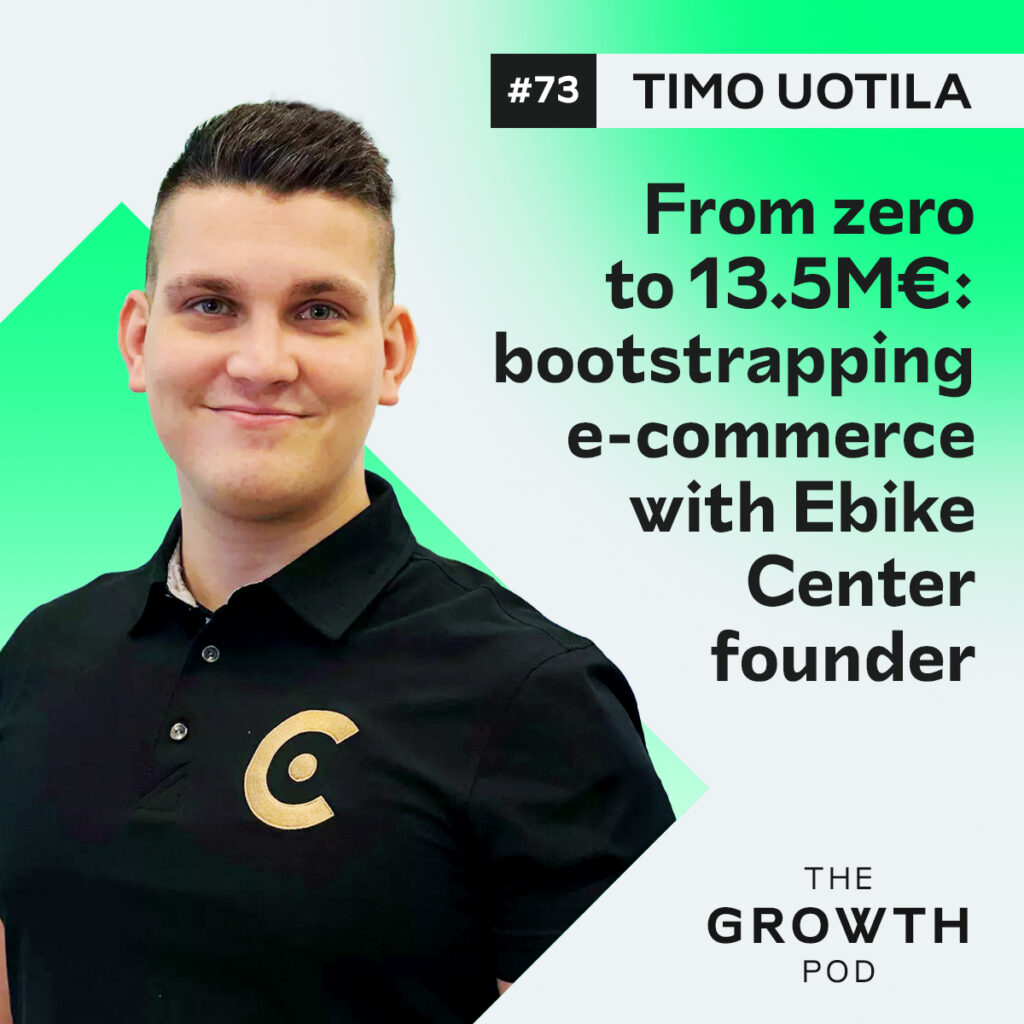
How do you profitably grow from zero to 13,5M€ in revenue, with just 20K€ in funding? We sat down to discuss this with Timo Uotila, who co-founded Ebike Center with his brother in 2023. We talk about entrepreneurship, common mistakes, lessons learned, building a premium brand, and navigating crises along the way.
3 takeaways from the conversation with Timo Uotila
1. Cash flow is the real growth engine
Ebike Center’s growth wasn’t driven by funding rounds or aggressive expansion plans, but by tight control of cash flow. From the start, Timo and his brother focused on best-selling products, fast inventory turnover, and reinvesting profits back into the business. This discipline allowed them to scale without external funding while staying profitable.
Bootstrapping forces clarity. When every euro matters, decisions naturally prioritize what actually sells and what keeps the business healthy. Over time, this approach also built trust with suppliers, unlocking better terms and making growth even easier to sustain.
2. Speed beats certainty in moments of crisis
When a government bike benefit (a major driver of demand) was suddenly put into question, the entire market slowed down. Customers waited, competitors hesitated, and uncertainty froze buying decisions. Ebike Center chose a different path and acted immediately.
By guaranteeing the benefit themselves and adjusting pricing and messaging within days, they removed uncertainty for customers and kept demand moving. The lesson is simple: when markets pause, the companies that move fastest often gain the most ground.
3. Premium brands are built through standards, not marketing
Ebike Center didn’t become a premium brand through slogans or campaigns alone. It was built through consistent standards across stores, service, hiring, and partnerships. Every touchpoint was designed to feel professional, reliable, and high quality, even when it meant higher costs or more work.
This mindset extended internally as well. High expectations, attention to detail, and a refusal to accept “good enough” shaped both the culture and the customer experience. Over time, those standards compounded into trust, and trust became a powerful competitive advantage.
Watch the episode:
Transcript
Josua: Welcome to the show, Timo.
Timo: Thanks.
Josua: So you are the CEO and co-founder of E-Bike Center. Yes. Which is, um, you guys sell e-bikes, electric bikes, uh, both online and offline. Um, we talked about this before we start rolling. Probably the biggest, you know, market leader in Finland and probably also in the Nordics as well.
Timo: Yes.
Josua: Um, company was founded in 2023, and you’ve grown profitably and, and fairly rapidly, um, to a team of close to 50 people. [00:01:00] And revenues Last year was, uh,
Timo: 13.5 million,
Josua: 30 point million. And you, you, you did all this with like no external funding, right? It was, yes. The cash you put in
Timo: me and my brothers 10 k when we started
Josua: 10 K each.
Yeah. Okay. So that’s, that’s really impressive when like bootstrapping e-commerce to grow like that fast growth and profitably. I know external funding is very difficult, so we’re gonna, we’re gonna talk about how you did that. But, but yeah, like I said, you founded the company in 2023, so. Why, why start the company?
Why E-Bikes? Did you always know you were gonna be an entrepreneur? Like what, what led you to start?
Timo: Yeah, I think I, I have been always, uh, known that I’m gonna be an entrepreneur, but the E-bikes came with me from 2016 when I first time try it on epac. Mm. And it, it was like, I always know that you need to have some quick dopamine hit to your customers that you can [00:02:00] succeed in this, this, uh, business.
And, and when I first try it on eBike, it was like super fun, the drive. And, um, the thing is, I, I was, I think I was sold immediately and I started learning more about the e-bikes and I, I learned there is like quality E-bikes and there is, there is like motor pike e-bikes when you just go. And that there is huge difference on those.
And, um, and. I started working on the industry first, and then a couple years ago, me and my brother Mika, we was talking about that we, we should do a company, uh, together. And that was like, Mika was like working on big companies. So he have lot of knowledge on people leading, uh, building the infrastructure to, to the company.
And I know everything about the e bikes. Mm-hmm. [00:03:00] And, and I have really, uh, good relationship on the manufacturers already because I was working on the industry and, and then we, one, one night on the sauna, we just, now we do it and, and we did it. Yeah.
Josua: So you both quit your jobs put in the 10 K and
Timo: Yeah.
Josua: Okay. And what was the e-bike market? Like at the time, was it a growing, was it like popular? Like I, ’cause I don’t really Yeah. Know or remember
Timo: when we started 2023, it was, it, it, it gets hugely growing when the COVID was because Yeah, then the, we be able to s supply in the Eex and go to the forest. We had like 2019 the big growth and then the market was like over pullout of the products.
When we came from there, uh, was starting at big discounts and manufacturer had like big stocks right then, but we still, [00:04:00] there was, uh, this bike benefit thing from, from the government and, and we do the math that we just need to sell one e-bike per, per day and, and we are good to go doing this. So that’s why we, we.
And I know, I, I, I know then where was the best places to sell e-bikes? So of course we opened at our first door in and it was like day one. There was customers coming in, so,
Josua: okay.
Timo: So that was really good start.
Josua: Okay. So the first, the, the target for the first year was like one e-bike per day. Did you beat that or did you
Timo: Yeah, we heavily beat it.
Uh, in the first, I think after three months we was ready to open the all, so,
Josua: okay.
Timo: Because I am, I was knowing all the people in the industry industry and, and I have really good relationship on them. So I know one, uh, store [00:05:00] manager in and he went to fund to do it with us. So we then it was easy to move on the all.
Josua: Yeah.
Timo: And after that, I know one really good guy on Tam. Yeah. And then. Over done, done by.
Josua: Yeah.
Timo: That’s why Yeah.
Josua: It, it’s so much easier to get started when, you know an industry, like when you have the relationships Yeah. Manufacturers, partners, everyone. Uh, but it sounds like you did not have to go out and create customer demand because you were growing so quickly.
Just basically you had the, the stores and people just came in, or did you have to go out and advertise and create awareness?
Timo: Yeah, yeah, we did that a lot. But I think the, the thing is that there is no, in biking, like brand stores, there is bike shops, what sells every branch. But uh, I know in auto industry you have like this massive, uh, Mercedes store or brand stores.
So we, uh, we was like, first we’ll take the troll.
Josua: Yeah.
Timo: So, so that was huge, huge [00:06:00] benefit to us because now we, we can, uh, do all the warranties on the all high bikes to direct these brands and we are so close with the manufacturer that we. The, the logistics are so easy to us. Yeah. Because every problem, we can fix it immediately.
And it was really, uh, nice to scale fast because we was in this position and not buying ev everywhere, ev everything. Yeah. That’s, how,
Josua: was that like one of the insights at the beginning that led you to start the company that we’re gonna kind of professionalize and create this brand store? Was that like a part of the strategy from the beginning?
Timo: Yeah, that was the idea in the, uh, in the first, because there, we, we had talk that a lot with high bike and it was always some talks and they, they wasn’t sure. And then we called them and, and, and, and asked that, let’s do this.
Josua: Mm-hmm.
Timo: And, and it, it was a great idea.
Josua: So going back to what you said about starting with [00:07:00] 10 K and then growing very, very quickly to now, uh, last year, 13 million.
Um, you have to buy a lot of bikes to sell that much. And, and so, you know, with, with, um, without any external funding, that’s, uh, you have to get the inventory purchases just right. Yeah. Like, you have to know what you’re buying when you buy it and get the timing and everything. So how did you figure that out?
Like
Timo: Yeah, thats
the
Josua: key. Yeah,
Timo: that was the harder, hardest part. I, I think because, because, uh, of course in Finland you get this, uh, fin where tacos
Josua: Yeah. Like guarantees. Yeah,
Timo: guarantees. So we, we, we learned, uh, some money, I think a hundred thousand with that. And, and we, we just bought the bikes completely, I think with 80,000 and then.
I know the models, what are like the best selling models? See, we only buy the best selling models and we just scale that up. And after the, uh, I think the [00:08:00] manufacturer can see that our cash flow is like really good. There is Bill coming us, there is like 30, uh, days time pay. We pay it in two days because we have already sell it.
We need the more bucks.
Josua: Yeah.
Timo: So then we get bigger loans on their, their after a worst year and then after the second and, and the trust, uh, compounded.
Josua: Yeah, I think, I think it’s also like when you have, when you don’t have a lot of external funding, you build your business differently. Like you pay attention to the cash flow.
Um, you pay attention to margins. You have to be more careful about how you spend your money. I think, um, it’s probably you will end up building a better business because you have to.
Timo: Yeah.
Josua: It’ll be more profitable. It’ll be more sustainable.
Timo: And also I think not many, uh, new entrepreneurs doesn’t know this, but even the tax code in Winland goes like, if you sell this month something, [00:09:00] you pay the tax in, uh, pay the what tax in next two months after two months.
And if you buy something, you get the money right away. If you are sure you can sell next month a lot, you get that also, uh, help you growth.
Josua: Yeah. Okay. So you, uh, was that kind of like when you think about the, all the financial modeling and planning and all that, was that on you or was that your brother doing all
Timo: that?
I think together, but uh, I was more on that side. Yeah. Because I have the experience on, on different, my job was in the previous is, uh, buying bike selling thing, so that was like my expertise.
Josua: Hmm.
Timo: Yeah.
Josua: Speaking of your brother, you guys started the business together. You had, it sounds like you were quite clear on like what skill sets and experience each one is gonna bring.
Timo: Yeah.
Josua: Which probably helps. Um, what do you think are the pros and cons of [00:10:00] starting a business with family?
Timo: Yeah. It, it, it can be really, um, I think you need to trust each other a lot. And there, there can’t be any kind of, small things cannot matter, matter because if you start too much thinking of those, you’re gonna end up fighting.
But we that out before we started that we, I think we haven’t have in now three years, I think One white mm-hmm. A little bit. And then we talk it through, we, we, we, we go somewhere and we talk it through and then it was like better than ever after that.
Josua: Mm-hmm.
Timo: So, so. I, I don’t, don’t see any problem with that.
I, I see it, uh, pros on that, that you can really trust your brother. He, he don’t gonna, don’t gonna do you bad if, if he, he is your family.
Josua: Yeah.
Timo: But yeah.
Josua: And, and trust makes [00:11:00] everything easier and you can move much more quickly Yes. To make decisions more and so on.
Timo: And you, you don’t, uh, train yourself of thinking about that kind of problems.
Yeah. You can focus on real problems.
Josua: Yeah. Exactly. Exactly. Um, did you guys have, like, uh, did you guys have like a shareholder agreement and were you thought when you started the business, like where you thought we discussed all these things different, you know, what happens if one of us wants to leave?
All those kind of conversations? Or did you just kind of
Timo: Yeah, we, we made that, uh, verbally and, and when we started, I think. Thing. Things are going so fast that we, once a month, we are like, Hey, we need to do the contract. And, and there comes something more important, but I, I think we are going to make it because Yeah, just the piece, were in both ways.
Josua: Yeah, yeah, yeah.
Timo: But there is no rush on it.
Josua: I think that’s quite common that, you know, it’s something Yeah, you know, you should do, but, uh, you don’t really end up [00:12:00] doing it. Um, so you had this growth and been been profitable. So, you know, if you just look at the numbers, like in Finder, you think, oh, okay, this has been a like steady, smooth sailing.
Um, but in reality there’s probably been a lot of mistakes, a lot of stress worries, and so on. Uh, anything that stands out as you’ve kind of been scaling? Any, any major
Timo: Yeah.
Josua: Challenges?
Timo: Yeah. I think, uh, now because we have made, made those mistakes, we have learned a lot. So now I can say we, we could do this much better and this, and this and this and this, but without that knowledge I would.
Take the same path, I think. Okay. Like there was nothing major. Yeah, there was, but uh, like these bike benefit things, it shutter a lot of things from us because we, uh, invested a lot of money. This, uh, our own bike benefit app and we hired a couple of people working there and building that up. And I think we was [00:13:00] ready, we built that Lego one year.
So I think there was a lot of money to be wasted. And after we was ready, the uh, news come that that white benefit tax free gonna wipe out and then we need to shut down the full break. But other than that, I don’t think we have made any mistake that we can reverse.
Josua: Yeah. Yeah, that’s, I mean, I think that’s key probably.
Jeff Bezos of Amazon had this, he talked about type one and type two decisions and I think type two decisions were decisions where you can kind of like open the door and go in and it’s like you see, okay, this was not good. You can go back. Yeah. Like you can reverse it and type two decisions. You can make those very quickly.
Timo: Yeah.
Josua: Type one decisions you need to be very careful.
Timo: Yeah. That’s, that’s actually really, really f Yeah.
Josua: He got, yeah. Uh, okay. Let’s talk about the bike benefit. ’cause that was a, how much did they, what was the subsidy like in euros per like, that the government, uh, [00:14:00] gave to people?
Timo: Yeah. It was like if you get a e biked or bike, uh, through your employee e so you get this, uh, you don’t need to pay income tax mm-hmm.
On the bike.
Josua: Yeah.
Timo: So if you have like 3000 euro salary, uh, you’ll take the 100 euro of the, that it out from the bike. You don’t need to pay tax on the hundred euros. Okay. So you get like. It depends your tax percent, but you get like 30% discount on the bike.
Josua: Okay, got it. And how big, like, was that a big, big driver of demand?
Timo: Yes,
Josua: that was a big deal.
Timo: That, that was really big deal. I think when that was like 60% of the epacs was sold that way.
Josua: Okay.
Timo: So, so the news was big when it came and Yeah, and, and it, it, it was like a, a really, really bad moment because it was, the 2024 was, was [00:15:00] end and it, it was like real nice growth and everything.
So we was. Me and Mika was like, now, now we go, gonna do even, even more. And we, I think, tripled our marketing market. We opened two our biggest shops right now, spo, it’s I think 1000 Squares and Turo also one 1000 squares. And those, uh, open days was like 20, 25, April 21 day. And the news comes in those openings.
So, so yeah. If we needed to make huge people that, so
Josua: you, you triple your marketing budget, you’re open to the stores, you spent a year building this app.
Timo: Yeah.
Josua: And, and then the news comes that something that’s been responsible for 60% Yeah. Before B Bikes is gonna be taken away. And how quickly was it, what was the period before the, between the news and it’s being faded out like.
Timo: I think next day it stops. [00:16:00] It’s
Josua: Oh, it was like immediate.
Timo: Yeah. It, it was immediate. And the bad thing about that was like, it’s, it wa wasn’t like lock tight that it’s gonna disappear. It was, it might disappear in, in end of the year. So if you are a buyer
Josua: mm-hmm.
Timo: You don’t really want to buy the e-bike because if you buy it through the, uh, bike benefit and it goes away, you’re gonna pay like triple time.
The double time what? The bike? 30.
Josua: Mm.
Timo: But if you play safe and buy the bike on your own cars and it doesn’t go away, you lose like 40% discount.
Josua: Mm.
Timo: So the, the customers was like, really it, I, I can’t, I need to wait to the government and the government keep that same one, one, uh, line in there the full year.
So, so I know that day that we need to do something though. Don’t stop the people. Uh. It’s keeping that, that the thing that, [00:17:00] uh, we did debate.
Josua: Yeah. Um, so, so let’s talk about that. ’cause I was, um, I was talking to a friend of mine, entrepreneur, and, and we kind of came to the realization that in any company’s history, there’s like maybe a handful of critical moments where, you know, you have your strategy and all that, but like there comes a moment where you have to make a decision and those decisions have like a huge impact on, you know, you could have two companies and they’re kind of like close for competing and very close.
And there comes a moment, like for instance, COD and then make vastly different decisions and one just goes down. Yeah. And the other just, so that was probably one of those like really Yeah. Pivotal. So can you walk through like, what did you, as a team, how did you approach Yeah. That situation and what decision did you end up making?
Yeah.
Timo: It, it was, uh, dramatic day day. I, I was in ku, uh, on those openings and, uh, and I, we had this. Apartment there. Uh, and, and I, I was sleeping on the couch, couch and I woke up like [00:18:00] 7:00 AM and I, I watched our WhatsApp group in the company and there was like, in the night came from like 80 of WhatsApp messages and I start reading those and, and the Paris was like, our sies, our top is our top.
It’s going to away or something like, like this kind, our employees. And I was like, what the fuck? Really? And, and, and after that, uh, I called, uh, our suppliers and we talk about this and then the, all the, the bike benefit companies called me and we talk what is happening on, and, and then that this thought come to me that now they, they’re not gonna buy any, anybody not gonna buy because you need to wait.
Which is wiser.
Josua: Mm-hmm.
Timo: So I drive that day from the openings to Espo to meet, uh, the suppliers, manufacturers and our marketing team. And, and then we get, get this idea that [00:19:00] we need to say that loud, that, uh, before that decision making on the government, uh, has ha hasn’t been made. We give that same, uh, same benefit to you.
And if that go government, uh, decision going to be positive, you get double offers. You, you get our benefit and then the government benefit. And if it’s not, you get the same that before. And that was the idea of pricing in this situation back to back to up. And. Uh, we were starting this pretty big brand marketing in on like big before and we was, lot of our part was in there.
So I remember I calling this, uh, our marketing, marketing, [00:20:00] uh, worker or freelancer. The, the, you need to shut down the full, full brand, uh, campaign. And she started crying because if she was like, we have like, I think 100, 150 different variation of picture as, and she just finished putting those in different things.
And, and then we, we talk about this and we made this campaign with, um, get this discount and the 36, uh. Month payment plan without interest. Mm. And we go all in off on that.
Josua: Hmm.
Timo: And I think it take three days and the numbers go really up.
Josua: Hmm. Okay. So, and how did the rest of the industry react? Did they do something similar or,
Timo: yeah, we, we, we was waiting what, uh, they were gonna do, but in the next three [00:21:00] weeks after that news, because that was the high sea best big season, nobody didn’t do anything.
Mm. So, so that was really cool to us. And I think it takes like one or two months and then everybody reacted on the same time.
Josua: Mm-hmm.
Timo: But we get free time two months.
Josua: Yeah. Okay. That’s interesting that, why do you think they were so slow to react? Because they saw you, I mean, you were o you were communicating your
Timo: Yeah, I, I, the harder, hardest thing to react in that because the bike business, it’s really on those.
Those months, like those spring months, uh, April. Mm-hmm. I don’t know the English version of those months, but it’s on there. Mm-hmm. So you can’t, you, uh, there is so much organic traffic coming to you, so it’s hard to keep this card on them.
Josua: Yeah. Yeah.
Timo: And, and, and [00:22:00] that’s why I think everybody was like, okay, let’s wait a month or two and 10 reactive.
They wanted to see the data, what will happen.
Josua: Mm-hmm.
Timo: And we like, uh, I think we just note what’s going to happen.
Josua: Yeah. Well, and that brings to something that we discussed, uh, earlier before about being data-driven and probably we’re just good and there’s a lot of talk, there’s always been a lot of talk about being data-driven in marketing and, and.
Um, but you have to combine it with some kind of
Timo: Yeah.
Josua: Judgment and intuition. Like when you know the market, when you know, when you’ve talked to like hundreds or thousands of customers and you know how they think.
Timo: Yeah.
Josua: Um, that, that forms like that, that intuition is very valuable. And then you have to make a decision because like you said, if you spend one to two months to see, to gather the data, to see how the market’s gonna react, then you’re giving someone like you Yeah.
Two months, two, three months to kind of grab market share.
Timo: Yeah.
Josua: Um, [00:23:00] so that probably, and it probably helped that you, uh, are you and your brothers, you were the only owners of the
Timo: Yeah.
Josua: So you guys can make a decision. You don’t have to consult with anyone. You can make a decision and just go for it and take a risk.
Timo: Yeah. That we have been a lot, lot of that kind of decision making.
Josua: Yeah. Yeah. Okay. Yeah. That, that, that’s really interesting. Was that also like, was that a pivotal moment? Like, did you take a lot of market share? Did that, was that like a, a big jump for you guys?
Timo: Yeah. Yeah. Yeah. I think we, in that first month when that, uh, news came, we doubled our expectation of that month.
Mm. And then we just Right that wave to the end.
Josua: Yeah. Yeah.
Timo: Of the year.
Josua: Okay. And I think, and, and that kind of leads us to, I wanna talk a little bit about marketing, communication, all that, and branding and, um, I think that’s like such a good example of what marketing, branding and all that, like, communication really is [00:24:00] about like, identifying something, uh, and coming up with, with a message that’s so clear and it speaks exactly to like the customer’s pain point.
Yeah. With like, we’re gonna, don’t worry about the government. We’re going to give you this guarantee and we’re gonna give you 36 months interest free. Um, so. When you, uh, before you started e-bike center, did you have, were you working actively in marketing, branding, communication, or? I was a sales guy. You were a sales guy?
Timo: Yeah. Well, yeah. My, my job is really much, uh, different now, so there is lot of change, change, change changes every, every month on the story of PAC Center, so we have to learn fast. Yeah.
Josua: You probably, I think that’s, it’s always interesting when someone comes from a sales background and goes more into kind of like Yeah.
Marketing and growth because, um, when you’re used to selling, I mean, you have to sell, like, you know, first of all, you [00:25:00] know what works because you can see it like, either I close the deal or I don’t.
Timo: Yeah.
Josua: And you get to try out a lot of different things, and I think a lot of marketers probably forget that marketing should also be about selling.
Timo: Yeah.
Josua: It’s, uh, eventually. So like what did you learn? What have you taken with you from your sales background that you’re applying now as you’re thinking about leading and building eBike?
Timo: I think mo mostly from the sales that what the customer actually wants. So, so
it’s hard to put this in in English. Uh,
I think there is a lot of coming, like what we are gonna advertise, what, what is the real helpers on our customers? So is it like more warranties? Is it the payment? Is that really good? But I, I don’t think, [00:26:00] no, no one, but who is working for sales knows everything about the customers because the data is so big in one.
One says called Gand. Can’t see like 10,000 of customers and remember, but those like, so there the data comes to help.
Josua: Hmm.
Timo: But yeah, there was been good, good things, but I, I think the best thing is about really moving fast and one the go want to do better.
Josua: Mm.
Timo: Better because I think the major thing in our company was like, me and Mika, we never, never thinking about that we are great.
That that’s never on the table. Because when we start, we, we was really small company and we paid a really big, uh, advertising company to get their best, uh, guys to do our, our marketing. So normally that was like really stupid because cost wise this was huge [00:27:00] cost and small company. But that make that we started to do the right things, we get the better knowledge and we.
The, we do that in ev every part of our company. Mm-hmm. If we buy a sales manager, it, it need to be somewhere top and we just need to tell him that we are good place to come.
Josua: Mm-hmm.
Timo: And then he can build really nice things.
Josua: Mm-hmm. And, and it, it seems kind of obvious, but not a lot of companies don’t do that.
’cause
Timo: it’s risky.
Josua: It’s risky.
Timo: Yeah. It’s, it’s expensive and very risky.
Josua: Mm.
Timo: Yeah.
Josua: How did you figure out, ’cause it, let’s say with the marketing guys you hired, um, ’cause it wasn’t your era of expertise. How did you figure out which ones to, to pick? Like how do you figure out who’s the best
Timo: learning? Uh, I did with different, uh, I did work with those officers and, and if you do [00:28:00] a lot of work with with them, you are gonna see who’s gonna bring.
Something new at the table and we’ll have the drive to do those things. And I think, uh, and the really good, good deal on those was like there in me that I’m really excited of this marketing thing. I want to do those. And I also can learn a lot, lot, you know, small time. So we get this hyped and then they want to work in this company because they see the potential.
Josua: Yeah, I think that’s absolutely true. And it’s just like a side note because people maybe don’t realize it, that like, depending on, you know, as a marketing, if you’re working a marketing agency, like if the customer’s really excited, like generally passionate, that’s gonna uh, catch on to the marketing agency as well.
Yes. That’s gonna impact the work they’re doing and they’re gonna be more excited and more creative.
Timo: Yeah.
Josua: And they’re gonna maybe work extra
Timo: Yeah.
Josua: To, to make it. Um, so I think people don’t necessarily [00:29:00] realize that it’s a big benefit. Um. To having that kind of like energy and uh, optimism and passion for what you’re doing because no matter what partner it is, marketing agency.
Yeah. No matter if it’s you trying to recruit someone like that, it’s, it’s evident.
Timo: Yeah. Yeah. That, that’s, that’s really, really a think because I, I have seen in my past, like, if you are like this normal businessman and you want to buy, buy agency to do you something, if you really gonna go see on those, like you, you, you, uh, want lower prices and you want more and more and more and more, nobody gonna like you in that, that agency.
And, and you are never gonna get, get a good, good profit on that.
Josua: Mm-hmm. Mm-hmm.
Timo: So if, if you are like that, then don’t buy anything, don’t do it yourself.
Josua: Yeah. I think that’s a problem that we have [00:30:00] generally speaking in, in, in Finland, is we try to be. Um, we try to be, um,
Timo: cost wise
Josua: Yes.
Timo: Two cost wise. Yes,
Josua: yes, yes.
And we lo end up losing a lot of money.
Timo: Yeah. Because of it. I have, uh, uh, heard a lot of, like, I, I, I am crazy when, when I don’t, I, I don’t usually, like, if I get offer, I either I take it or I don’t because if I ask, ask, uh, 20% discount and I get it, I have this feeling on my, my, my back that there is something missing.
Like
Josua: mm-hmm.
Timo: He don’t gonna do, do all it for me.
Josua: Mm-hmm. The,
Timo: the mindset should be perfect on, on, on the freelancer or agency or, or something that you’re working with and the boat. Boat need to be benefit visual and, and, and, yeah.
Josua: Hmm. Uh, so you started with, in the beginning, were you using more marketing agencies and then at the same, [00:31:00] like over time building your in-house marketing team or
Timo: Yeah.
Last year we, we still used a lot of agencies and this year we have no agencies. Okay. So we do all it inside the house.
Josua: Okay. And what are your main, like, is it, um, mainly digital? I’m guessing obviously, but um, like is it Google ads or do you get a lot of organic, a lot of paid social,
Timo: a lot of tools, lot of,
Josua: lot of everything.
Timo: A lot of everything. There is, yeah. I think we have like 10 channels. Yeah. Think where we, we really invest.
Josua: Okay. And, uh, do you track the, you know, awareness and market share and all that? Because I’m guessing, I mean, Finland is a fairly small country. You’re
Timo: Yeah.
Josua: Becoming a quite big player. Like do people know about you?
Do you still have to go out and create a lot of brand awareness or how does that,
Timo: uh, of course we, we do that because we did that. That the brand need to evolve, but I think we only are [00:32:00] focused on the conversions.
Josua: Mm-hmm.
Timo: And we do the branding on those. I need to ask my marketing leader now, but we are doing right now.
But when, when I was, when I was leaving that we, we focused mainly on the conversions because we needed the money and we need to grow and we didn’t have anywheres money to burn out.
Josua: Yeah. Yeah. And what have you learned, because that’s a, that’s a whole topic about, uh, how to optimize for conversions, uh, to get people to actually buy and get them through the whole buying journey.
Um, anything kind of that stands out that you’ve learned, uh,
Timo: a lot that is like, so big topic that we should take 10 of these meetings, the open that, but, but. The, the only easy way to put it is you need to have some people that know, know on those things and then get those work together and learn new things and [00:33:00] use their relationships to learn new things.
And I think still now in every week we get something last, oh, we did it, uh, we do this, do this wrong way all the time. And there’s lot, a lot of changes happening there. But yeah, I could, I could say it is in confidence that we are really good on tos if we compare on the pike industry. That is one, one key thing that we do.
Really good.
Josua: Hmm. Yeah, I think it’s, it’s interesting to see, because I think this is true across almost probably any industry, is when you start looking at companies, they’re not thinking about these things.
Timo: Yeah. And you need to invest a lot, a lot of money on that. Mm-hmm. Uh, I think we have probably last year we invested more than half a million the things, so,
Josua: okay.
Timo: So that is, I think that is [00:34:00] our biggest invest
Josua: Yeah. That
Timo: we do.
Josua: And that, is that mainly the website or just everything?
Timo: Yeah, everything. Everything. I don’t wanna open to Yeah. Yeah.
Josua: But it’s, so, it’s a significant investment. That goes back to what you’re saying about, um, if you’re, if you’re trying to be the market leader, you know, you have to hire the best people.
You have to make the investment. Like it doesn’t come, it doesn’t come free.
Timo: Yeah. And the hard, hardest part on that, it, it, the, the price doesn’t come immediately when you invest and you just need the, just need the. I, I don’t wanna say hope because that’s Trust.
Josua: Yeah.
Timo: It, it’ll come when you are, when you are the best and you can track it like watching other companies, your, your competition, what they are doing, what you are doing.
And there are so many tracking tools right now available for 100 euro per month.
Josua: Mm-hmm.
Timo: So, so yeah, you can track that. Your [00:35:00] investment.
Josua: Yeah. Are there any like, maybe not even competitors, but just companies that are doing really well that you kind of benchmark or look at? Yeah,
Timo: we had benchmarks. Lot of, I think till last year.
Now we are like this point that we need to find a new benchmark. I am not sure what it is right now because that we need to figure out.
Josua: Yeah.
Timo: But, but yes, we had, I think. Co. Couple months ago, we, we go over, over that our benchmark.
Josua: Mm.
Timo: So we started doing new things that we know that they were aren’t doing.
Josua: Yeah. But when you think about conversions and just driving sales and growth, is it, does it feel like you figure out like the 80% and now you’re kind of fine tuning things? Or does it feel like they’re still potentially like you could double what you’re already doing now? Like
Timo: Yeah, easily.
Josua: Yeah.
Timo: [00:36:00] Now, now we are, we, we are, we are just built the platform and now we need to scale this a lot.
Josua: Mm-hmm.
Timo: So, so I think we, we can grow a lot more than than Dish.
Josua: Mm-hmm. Mm-hmm. Um, what was I gonna ask?
I forgot. Uh, well, so wanted to go back to, ’cause what you mentioned about, uh, about brand and previously that was something that you didn’t invest in because, um, you wanna just focus on conversions and that makes sense because. Doing like these general broad brand campaigns is not really, doesn’t really make a lot of sense when you’re bootstrapping.
Timo: Yeah. And I, I think we invest in a lot of brands, but different way. Mm-hmm. Uh, our stores are like so different world than our competitions.
Josua: How so?
Timo: Uh, you need to visit one. You see it immediately. We have, uh, did lot of money on [00:37:00] those, those stores. And there, there is like when, when you come there, there is like never anywhere row of bikes, everything have display it.
We have screens and, and foods where the bikes are and, and, and the, the, the people are, everybody have, like our industry, they have their own. Small offices and they can really help the customer. It, it’s really different to buy the bike from us than I think anywhere else. Mm-hmm. It’s, it, it’s different, uh, what is called like experience.
Josua: Mm-hmm. Mm-hmm.
Timo: Experience.
Josua: And that’s a combination of the store and the staff and uh, the,
Timo: that is something
Josua: selection.
Timo: Yeah. That is something where, where Mika is really good and he has done, I think, a wonder wonderful job on that.
Josua: Mm-hmm. So like you mentioned, you’re now about 50 people. Um, most of them working in the store [00:38:00] or,
Timo: yeah.
I think in my team there is five people on doing e-commerce and, and, and that kind of things. And of course we have some people on the restaurant, I think English version and, and uh, and the payments and everything. But I think 40 people is on the stores.
Josua: Mm-hmm. And how did, um. I’m guessing you, do you train them all yourself?
Do you have to have experience before coming in? Have you built like your own?
Timo: Yes. They
Josua: training programs?
Timo: Yeah. Uh, mostly we, we, I think we had bigger salaries than the normal companies in our literacy. So we get is easier that the most, uh, knowledge people. And now when we are grown and we look good, every, we get really, really, I think, weak on a amplement from other companies to come work to [00:39:00] us.
Josua: Mm-hmm. Mm-hmm.
Timo: But now I lost my words.
What was the question?
Josua: If you, the training, like, but it sounds like you’re able to hire the best people essentially.
Timo: Yeah. Yeah. Now, now I get it. So, so. So the good thing is in, in our main, main office there is upstairs, the manufacturer. There is high bike, there is rum, rock, socks, uh, there is like every manufacturer of our products.
Hmm. So we are like once there away. So we can learn a lot from them and, and they give us, uh, know that is when anything new coming. And of course we have on inside, inside, inside of our house. We have like this technical Tuesday when [00:40:00] our most technical guys do teams to everybody and learn new things.
Yeah. I think we focus a lot of education of the bikes.
Josua: Hmm. So it sounds like you had a very clear from the very beginning it was. We’re gonna build these branded stores, we’re gonna take the whole customer experience to the next level. Um, both in terms of the store, uh, both in service staff, the online, you know, everything has been kind of like focused on building this premium
Timo: Yeah.
Josua: Experience for, for customers. And then that has like consequences for probably suppliers who wanna work with you, employees wanna come work for you. Um, customers wanna buy for you because you’re like the high trust player. Would you say that, like, has that, was that the, there was like a clear strategy from the very beginning that you’ve just been executing on?
Or have you had to
Timo: Yeah. Uh, yeah. And, and we, there is like, we have three brothers, me, Mika, and also we have this [00:41:00] sales manager, Tony, that is our brother. Uh, he’s been executing that thing really good. And, and the, the, also, the good thing was like, then we started working with, with High Pike. Uh, we lower them.
Uh, warranty cost a lot.
Josua: Mm-hmm.
Timo: Because in our building program, when the bike come from, from us, we, we have these guys from the first place when we started who was like working with high bike 20 years. So they, they know all about the small problems if there is, and they build us very different building construc.
Oh yeah. Building
Josua: instructions.
Timo: Instructions.
Josua: Yeah.
Timo: So, so that, that, that made, made it like our, our warranty is really small project. It’s, [00:42:00] it’s much smaller than the, the median on the industry. Mm-hmm.
Josua: Okay, so,
Timo: so, so the manufacturer likes that. And Yeah. Also, also we get benefits on that. Okay.
Josua: Hmm. Yeah. So it sounds like you’ve really thought about, been thoughtful about all the different areas of the business and how they all support, support each other.
Um, what are your thoughts for the future? Like now you’re at this position where you are, you’ve grown really fast, um, you’re now currently in Finland, but you probably a lot of different cities where you could open up, or are you thinking international? Like what are you, what are you thinking? Or is the plan to continue growing?
Or do you wanna take it easy?
Timo: Yeah, it, it’s plan to grow. Now we are making these processes much smoother, much better, and also our, our cost on conversions better. And, and we are doubling our volume to produce high quality bikes in our, our, uh, [00:43:00] services. And also we are now doubling our capacity to take service customers.
Josua: Hmm.
Timo: And after, I think we have this year, so where we are built and fried every process down and really clear
Josua: Hmm.
Timo: Then we are ready to go another country.
Josua: Okay.
Timo: But, but we really want the, the, it, our company be solid because if we, we are not ready and we go there, we are gonna have problems in Finland, then we are gonna have problems in there.
And all, all things gonna mess up this Finland need to work like, like really good before. Yeah.
Josua: That’s interesting. ’cause I think, I think there’s a lot of companies that would’ve gone international even earlier and that might very well have been a mistake for them because, you know, typically I’ve seen, seen that happen a few times where companies expand too quickly and they’re not, the whole market isn’t really solid.
And all of a sudden you have, you’re losing money in both [00:44:00] markets and it just, it’s a hard, hard thing. So like what gave you the kind of discipline to say, okay, we’re gonna first do these things, uh, you know, in this home market, and then we’re gonna take next
Timo: step knowing more, knowing more. Because if you have been asked that, that for me, like one year ago, I would say, we gonna go now in the international I, I, I was like, like that.
But then when I learned a lot, uh, e-commerce things, data things and everything, but we haven’t been done yet.
Josua: Mm.
Timo: And, and I, I see if you’ve done all of those things, what big companies does, then you have like, so easily run the company and, and then when you scale it to the different country, it’s gonna be lot of less pain in, in, in, in.
In that. So, so I, I started to being afraid if I now get my focus to come, go there, I’m not gonna build this good. [00:45:00] So, and I think after this year, we are so, so, so good place that, that we have time and, and we can do it.
Josua: Hmm. And probably like, not having outside investors also means that you guys can choose a timeline.
Uh, yeah, you can choose whenever you wanna have you, I’m, I’m sure people have reached out to you because, because of the numbers, you wanna invest or maybe acquire you, but your, your plan is to stay independent.
Timo: It depends. We, we don’t need money. So the, so we want to hear everybody. If there is some kind of what they can teach to something, of course we are interested.
Josua: Hmm.
Timo: But yeah.
Josua: Hmm. Um. I wanna talk a few, ask a few questions kind of general about, um, entrepreneurship and, and, and leadership and so on. And we talked off air. You mentioned like one thing that you’ve seen a [00:46:00] lot of in other companies is how easy it is to blame external factors. You know, we didn’t hit our numbers because of the weather was really bad, or government subsidy, you know, or go the market was bad.
Um, but it sounds like you guys don’t do that. Like you don’t, you’re not, you don’t allow that to become a reality for you. So how do, how do you avoid falling into the trap of kind just blaming the environment?
Timo: Yeah, I think in many meetings, the, the, when, if the sales have been going down and, and, and somebody says there that it, it, it was windy or, or, or something.
Something that kind, kind of, kind of way, uh. We, we stop it because that’s, that’s not ever true. Every time we had have been like sales going down day or two or three, we always has find the reason. It just [00:47:00] might be a little, little reason some product have, has moved out of the catalog at different place or there is so much, it is so small things when the customer is buying on web store, he has two different stores and, and he, he need to choose.
So, so I think most likely the reason is there or is it in the stuff or something. Something. So we just need to find the reason.
Josua: Okay. So basically that’s interesting ’cause I mean, there’s. In any business, there’s gonna be a natural fluctuation, right?
Timo: Yeah.
Josua: Sales are gonna go up and down depending on the sea, you know, day of the week or the season of the year or whatever.
And it’s so easy when things are going, when things are going good, you’re like, okay, it’s because we did this thing. When things are a bit down, you’re like, oh, you know, there’s a thousand different reasons, but, uh, external reasons. But basically it sounds like you don’t really accept that ever as a
Timo: [00:48:00] No, no.
No.
Josua: Okay. That’s good. That’s really, um, ’cause that, yeah. That’s really good. Um, one thing we also talked about was self-awareness and how important that is as an entrepreneur. Like you need to know, uh, well, you just mentioned that, like knowing how much you don’t know. Yeah. Um, how have you and, and, and your brother, like, did you, did you start off with a lot of self-awareness or was that something you kind of
Timo: Uh, I think my brother have it more because he is.
I think 20 years older than me.
Josua: Mm.
Timo: But 50 years I’m not true. But, but, but when we started, I was the typical sales guy. So I know everything and, and I’m the best. And that is true when you, you, when you are working like two to 3 million revenue company mm-hmm. You can basically do all of those things by yourself.
Josua: Mm-hmm.
Timo: But, but when you go up, there come this little thing [00:49:00] that called com competing competition. So when that comes, hits you, then, then the other people really have, the other companies have these skills. And I think only way to really learn it if you don’t know it, is to pay the price and buy a really, really good, good, uh, marketing guys or, or.
Or talking with them and, and you’re gonna learn, learn, learn vast that you don’t know a lot.
Josua: Mm mm
Timo: That’s my experience.
Josua: Yeah. But, and, but that also then requires you to be open to that. Like, ’cause often sometimes I, you see this happen when, see it happen when, when people, companies buy consultants or marketing agency or whatever, and, but they’re ego doesn’t really allow them to, uh, take the advice.
Uh, yeah. Because they do want to feel like they’re always the smartest person in the [00:50:00] room.
Timo: And also when you go in, in that first, first conference, uh, first meeting on, on, on some, somebody like that, uh, the, the thing is you really need to, need to inspire him to help you. It’s, it’s, if you, if you call like, ah, you cost like 300 euros per hour, 100 euros, mostly.
The, this environment change and it, you are not gonna get the benefit anymore.
Josua: Yeah, for sure. Um, what, ’cause I mean, this was the first company that you started and it’s now been three, four years?
Timo: Uh, actually second.
Josua: Oh, second,
Timo: okay. Uh, I started, uh, before this, uh, one of our competitors, not right now, uh, with two guys, and they were still, still in the market, [00:51:00] but, uh, it was really, really different mindset than what I was having.
So, so then I wanted to do it again with my brother.
Josua: Hmm, okay. Different strategy and
Timo: Yeah.
Josua: And yeah. Um, what’s been the hardest part about, so you had, I mean, obviously then you knew. You do not start completely from scratch, but what’s been the hardest part about the journey, uh, so far with, with e-Bike Center?
Maybe something that people don’t, don’t talk about when it comes to being an entrepreneur.
Timo: Yeah. It’s, it’s, it’s heavy. It, it, it, I think that the things are when you need to always be prepared, that market gonna go in anywhere and, and the positive thing on that is everybody are in the same situations, so.
Hmm. [00:52:00] Can you ask that question again?
Josua: Is there anything, I’m thinking, for instance, things that people don’t really think about that are difficult. It could be like decisions about staff that you need to take. It could be like, there’s the pressure of. Yeah. Uncertainty of not knowing, okay, we’re gonna buy this e-bikes for this many millions.
I don’t know if we’re gonna sell them. I think we are, but if we don’t
Timo: Yeah. I, I, I know a cool thing, um, in, in one year ago, I, I figure this out, that, that when we was building and, and, and, uh, rising, rising, uh, I, I have always this feeling that I, I don’t know where we are. I, I I, this is not together a anything.
And I was like, in this one hotel where they have this painting, and it was from Christopher co co post that you never been so far when you don’t know where you are.
Josua: Mm.
Timo: And, and I, I think that is something that’s what clicked on, [00:53:00] on my mind that, okay, now we are like, really going forward because I don’t know where we, where we are.
And you just need to some try to keep up and learn and learn and mm-hmm. Then you catch it and then you can. Also go now. I think I, I know where we are exactly. And what we are doing, but in, in, in this journey, there was a lot of, a lot of times where the pressure was really high because I really didn’t know, know where we are.
Josua: Mm-hmm. I think that’s a really good point because, um, and, and to kind of accept it that this is normal. Like it’s okay when I’m in a place I’ve never been.
Timo: Yeah.
Josua: I’m not supposed to feel any different. I’m supposed to feel
Timo: Yeah. But that’s the thing. But I, I try it to explain English.
Josua: I think that’s also true when, when it comes to companies, it’s like when you’re doing everything, when you’re doing something that everyone else is doing or someone’s done before you, then you can always benchmark.
You can look at, yeah, oh, [00:54:00] they did that, but when you are like, let’s take the example of the, the subsidy, like when the whole, when you’re the only one in the market, you react that way. You can’t look around because no one else is doing it.
Timo: Yeah.
Josua: Um. So even as a company, I think that that becomes scary because always, not always, but often when, or my experience when companies think about strategy, for instance, we always start by looking what has someone else done in another industry or what are competitors doing?
But, but to kind of build it up, the strategy from the ground and think about what makes most sense can be quite scary because you’re not anchoring it to something else. Yeah. And, and we as people, we get really scared when that happens. Like we want to have something to look at and someone else that we can point to and say, okay, they did that here, that, and it worked, so therefore we can do this.
Timo: Yeah.
Josua: Um, is there anything, I mean, we may have already talked about a few of those things, but is there anything that you find, you mentioned with, with, uh, when you started this, this, um, second company, [00:55:00] it was because you had a different vision and strategy that why wanted to pursue, uh. Are there things where you feel like you disagree with most people about whether it’s like branding or sales or marketing?
Are there like Yeah. Beliefs you have about business that you have that most people would disagree with?
Timo: Yeah. I think that is the biggest thing. Why, why, why this happened to the C park center. Because I think most, I think most Finn entrepreneurs and, and businessmen, uh, they think a lot, lot of cost wise and, and low cost and high profits.
And, and that’s how I, I also believe that kind. But, but you need the first gold at the high, high income be before you can’t really cut any costs. And, and, and, and I think. Everybody limits their thoughts, how big they can [00:56:00] get.
Josua: Mm-hmm. Mm-hmm.
Timo: Too much like, like, I need to reach this 1 million year revenue goal up.
And you don’t really think that you can do it that a hundred times. And then if you got the course, maybe it’s a profit. Margining is not that big, but the, the there is more money
Josua: Yeah.
Timo: On the table.
Josua: Yeah.
Timo: Yeah.
Josua: That’s a big, um, that, yeah, like you said, I think that’s really common and it shows in the e-bike.
I think that’s what’s so fascinating about the story because it shows that you can, with very little money, startup capital in a pretty short period of time, build a premium brand and a market leader if you have the strategy. Of course, lots of hard work and difficult decisions and, and all that. But like, um, if you, if you have consistently that strategy of building the best customer experience, attracting the best people and partners.
And all that. Um, it really works.
Timo: Yeah. Yeah, [00:57:00] yeah. And you go also, you, you just need to, need to have the courage to get the right guys and then get the right guys to the want to do that, want to do that.
Josua: Mm-hmm.
Timo: And, and then be, be really sophisticated, those small things. Mm-hmm. Like I, I’m always the guy, if he build this coffee cup already and I see one thing there, we are not ready before that, that thing that you think gonna bother me a lot.
And I, I, I do that like daily basis. I think our craft graphics designers Yeah. Hate me a lot because I’m gonna turn. Down then, then off their, their things. And then 11 is good.
Josua: Mm mm But I, I [00:58:00] think that I, I’m glad you brought that up because it feels like that’s always, um, to build something great. Uh, it takes a lot of that, right?
Yeah. It takes a lot of effort. I remember I was reading, uh, biography about Walt Disney and when they made Snow White, the first like, cartoon movie, and it was, uh, it was insane how much it was like day after day, like long meetings. Like he would just, like, he would never stop and everyone was tired and done and just wanted to get it over with.
It was like, no, no, no, we’re not finished. We’re gonna do another one, another one, another one. And he was obsessed. But that’s what it took to, to make this movie that won all these Oscars and changed the industry.
Timo: Yeah.
Josua: Um, yeah,
Timo: my, my wife’s wife tell me a lot, lot, lot about that because he, she, she comes on my office like in the evenings at nine o’clock and, and he, she ask me like, what, what are you doing still?
And I was like, I’m, I’m doing one hour shoot this little, [00:59:00] go be a little bit upper or downer. And, and, and, and then she get a bit mad, mad mad because I am facing my one hour of that. But that, that happens also, sometimes I, yeah, I can be really, really small thing.
Josua: Hmm. But that, but it’s like, because it’s so hard, it’s hard to, to know like, when is it something that doesn’t matter, like a detail that doesn’t matter versus a detail that does matter.
Timo: Yeah.
Josua: And I also think it has a huge impact. Like when you do that and the team sees you doing that, that like trickles down to the organization. That level of detail. And commitment to excellence.
Timo: Yeah.
Josua: You know, every, like, people see it and they start doing it themselves.
Timo: Yeah. Yeah. And also it, it’s smaller things.
If, if somebody is filming some video on, on some, some TikTok or some, some trend trend in our company and they send it to me. And I think everybody [01:00:00] knows now that if I see in the video on the left corner or something, something that doesn’t belong there, that video today get, get rejected every time. So, so, so they, they, they know before sending me that it, it need to be really, that was,
Josua: yeah.
Yeah. I mean, I think and think that’s a big part of leadership is like setting the standard or like continuously raising the bar.
Timo: Yeah.
Josua: Like we have to be better and better and better. And if you do that as a company, then you’re gonna succeed. And most companies don’t, then they don’t.
Timo: Yeah. And, and I, I don’t think this is nowadays, but in, in my time when I was working in different companies, uh, the leaders spoke like we are like family in the company.
And I, I, I, I, I was always hating, hating that, that phrase in, in, in, in, in my life. Uh, I think we are more like a, like a ice hockey team that, that now when we are on the top of the list on this ice hockey campaign [01:01:00] campaign. So we need to do be better than everybody else. So if you want wanna be in the number one team, you need to be good.
And, and, and you need to know that if you are not, you are not gonna be there long and you’re gonna go play with a different team. Yeah.
Josua: And the best people want to want to be on the best team and they want to know that they’re there for a reason. They’re, they’re because they’re good and they deserve their place.
Timo: Yeah. That’s if you had one, one bad people working with five good people. If you don’t, don’t, uh, I don’t wanna say remove him, but move him and different things. It gonna ruin the all five.
Josua: Yeah. Does Alright. Timo, thank you so much for coming on. Um, I think it’s, um, I was really glad to, to be able to have this because it’s a company that, um, your story has, I mean obviously it’s not like broadly [01:02:00] known, but it’s a, it’s a very great kind of growth story.
Um, we need a lot more of those in this country and I think we were able to kind of uncover some of the things without going just into like tactics and, and, and all that because it’s usually never about that. It’s about the strategy, the vision, the commitment.
Timo: Yeah.
Josua: Um, being able to take bold decisions.
Timo: Yeah,
Josua: being able risk and, and make investments that, that pay off.
Timo: Yeah. There is not exactly textbook that do this and, and, and you grow because it’s, there is competition, but those things are really, really good to have.
Josua: Yeah. So I’m, uh, you know, congratulations on the success. Um, we’re filming this in beginning of 26, so hope, hope and think that 2026 is gonna be a record year for you guys.
And, and hopefully in 27 you’ll take it, uh, go either south or, or west or, or somewhere and, uh, expand further.
Intro: Yeah.
Josua: Thank you so much. Thank you. [01:03:00]
Intro: Thank you for listening. You can find all episodes of the Growth Pod on Spotify, YouTube, and Apple Podcasts.