By Sebastian Östman.
In 2009, three young Swedish-speaking Finns started a marketing agency in a country where we didn’t even speak the language of 90% of the population.
It might sound like a punchline, but it was the start of Genero. We didn’t have a massive network or a local advantage. What we had was a simple culture and a core belief: if you care deeply about a client’s business, language isn’t a barrier. Caring is, quite literally, one of the best business strategies there is.
After 20 years of entrepreneurship — from selling log houses as a 19-year-old student to building a Nordic growth leader with over 70 specialists — I’ve seen every “game-changing” tech wave come and go.
But the shift happening with AI right now is different. It’s making many companies invisible, and most CEOs don’t even realise it yet.
The Death of the “Blue Link” Era
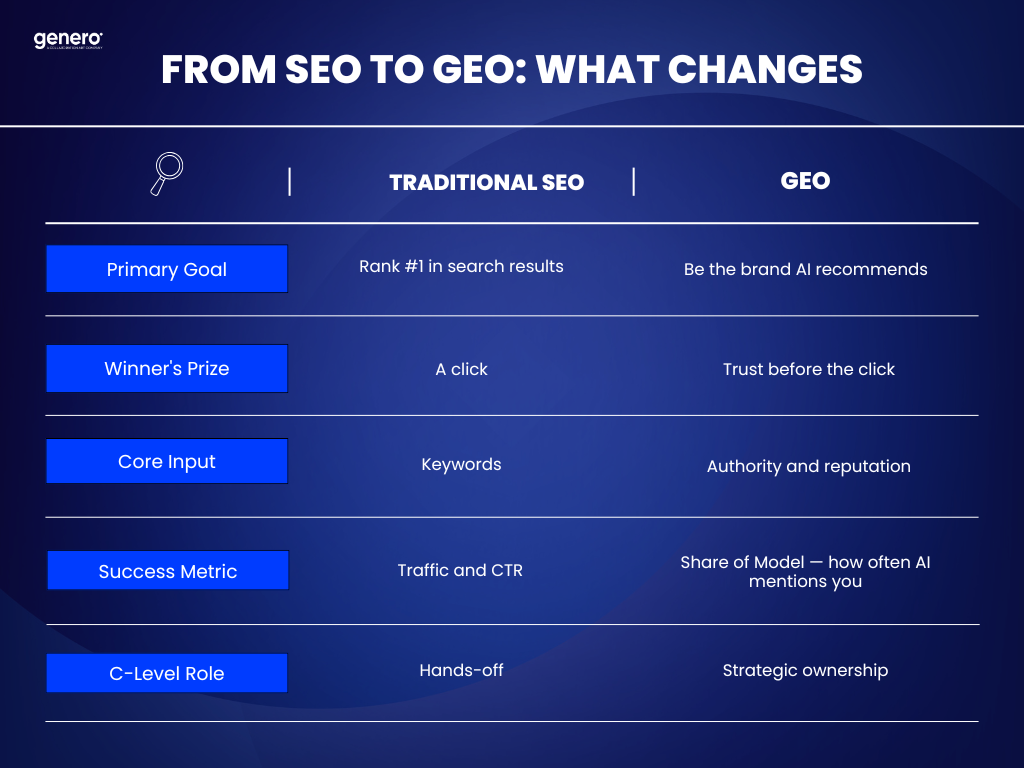
For two decades, the goal of a website was to rank. You hired experts to optimise meta descriptions and build backlinks so you could appear as a link on a search results page.
Today, when your customer asks ChatGPT or Google’s AI Overview a question, they don’t get a list of links. They get a definitive answer.
This is GEO — Generative Engine Optimisation.
AI models don’t rank you based on keywords. They mention you because you are a trusted authority referenced across the web. AI rewards brand equity, not technical optimisation. If your brand doesn’t exist in the data AI is learning from, your company effectively doesn’t exist to your potential customer.

Your Website Is Now a Brand Authority Signal
This changes everything about how you should think about your digital presence.
In the old world, a website was a destination — something you optimised so people would find it. In the new world, your website is evidence. It’s one of the primary places where your brand authority is either being built or ignored. Every article, every case study, every piece of thought leadership you publish is a signal that AI models learn from when deciding whether to mention you or your competitor.
This is why the CEO cannot treat the website as a siloed IT project or a purely aesthetic exercise. It is the cockpit of your brand’s authority in the age of AI — and the strategy behind it needs to be owned at the top.
Having been part of over 100 website projects, the ones that fail almost always have the same root cause: no one at the leadership level made the hard decisions. The CEO needs to ask three questions that nobody else in the organisation can answer:
Does this actually communicate what makes us different? When the team disagrees on direction, who breaks the stalemate? Is this genuinely a priority — or just something we say is a priority?
A project moves only as fast as the commitment behind it.
Learning to Love Change
Building Genero hasn’t been a straight line. I’ve dealt with cash crises and worked as a truck driver to provide for my family while building this company. Those difficult years taught me one thing above all else: the ability to embrace change isn’t just a mindset — it’s a competitive advantage.
Genero has now joined the Collaboration Art group, giving us access to 200+ specialists across the Nordics. Not as an exit, but as a platform to do more of what we’ve always done — turn marketing into profitable, measurable growth. The economic climate in Finland has been challenging, but blaming the environment is a choice. Focusing on what you can impact is also a choice.
My Challenge to You
Open an AI tool today. Ask it who the leaders in your industry are. If your company isn’t mentioned — that’s not an SEO problem you can fix with meta descriptions.
It’s a brand problem. And it starts with a decision to treat your digital presence as an asset, not a cost.
Let’s build the next growth story together.