
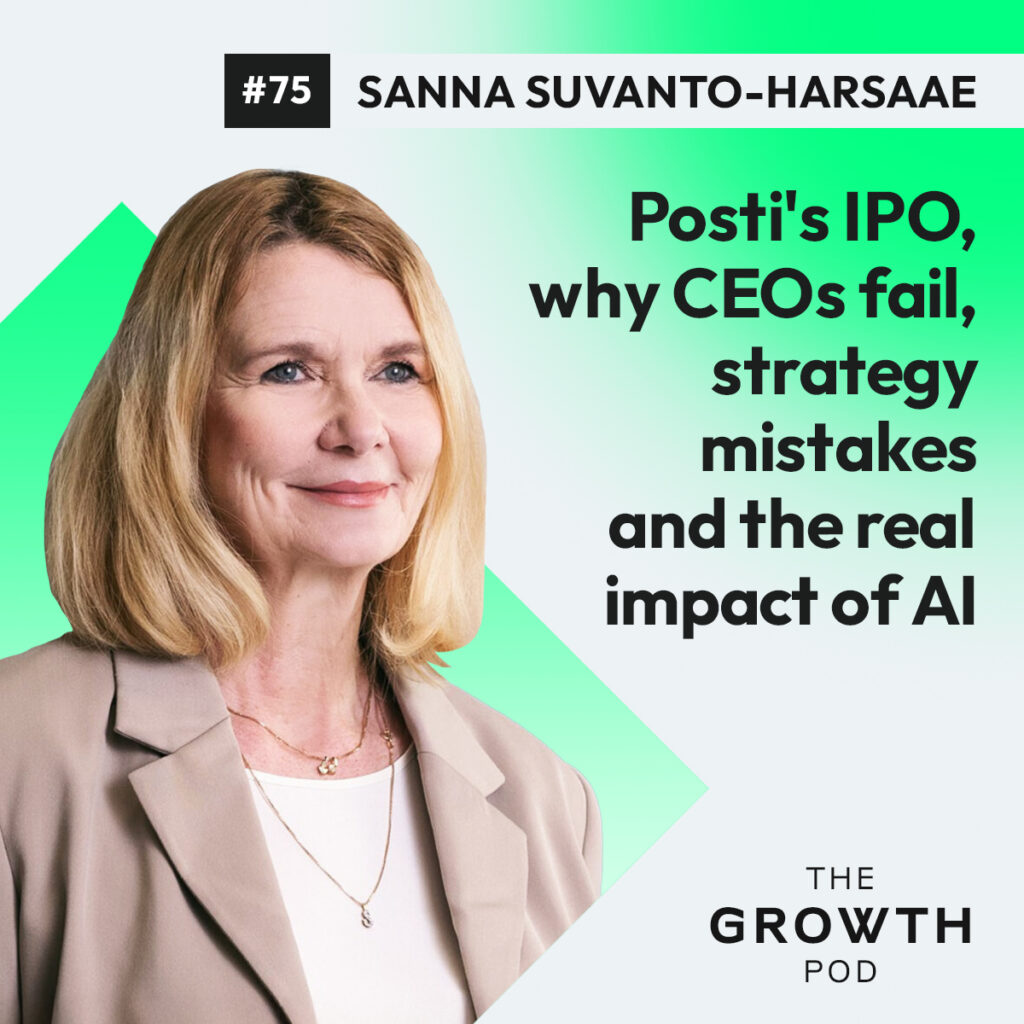
Sanna Suvanto-Harsaae is one of the most respected business leaders in the Nordics, chairing companies like Finnair, Posti, and BoConcept.
She returns for a third time to discuss good vs great leaders, “founder mode”, managing crises, making difficult decisions, the importance of focus and judgment, and the real impact of AI on business.
3 takeaways from the conversation with Sanna Suvanto-Harsaae
1. Great leadership requires clarity, focus, and the courage to make hard decisions
Sanna argues that many companies struggle not because the right answer is impossible to find, but because leaders avoid the uncomfortable choices. Turnarounds often start with a simple but difficult question: what is this company really about? From Posti’s IPO to broader strategy work, she emphasizes the importance of cutting distractions, killing internal “hobby horses,” and focusing the organization around what truly creates value.
2. CEOs fail when they lose credibility with the board and the organization
For Sanna, one of the clearest warning signs is when a CEO repeatedly misses the results they promised to deliver. That usually points to a deeper issue: they may not understand the business well enough, they lack the right plan B, or they avoid taking responsibility when things change. She also discusses why boards often wait too long to make leadership changes, and why keeping someone in a role they cannot succeed in can be more harmful than letting them go.
3. AI is already improving efficiency, but the bigger transformation is still ahead
Sanna sees clear AI impact in cost savings, automation, process improvements, and better ways of working. But she is more skeptical about claims that AI is already creating major new growth for established companies. Her view is that AI may become as important as the internet, but companies are still early in learning how to use it well. The biggest challenge may not be the technology itself, but how humans use judgment, make decisions, and keep developing real expertise in an AI-driven world.
Watch the episode:
Transcript
Josua: Sanna, welcome back to the, the podcast. Third time’s the charm.
Sanna: Amazing. A- amazing you keep calling me back.
Josua: Yes.
Sanna: Back on that one.
Josua: Um, yeah, of, of course. It’s, uh… You’re one of our, our most popular guests, and it’s… The only, the only bad thing is, um, every time we have one of these, uh, our, our conversations, it’s a reminder of how pa- fast time passes.
Sanna: I agree. ‘
Josua: Cause it just goes like this, and it’s kinda… But a- anyway, I think it’s been, like, one and a half years since, since we last, last talked. You say so. So what’s, what’s been going on in [00:01:00] your life? What’s happening? What’s… What are you excited about? What are you thinking about? What’s, what’s new?
Sanna: Oh, that’s a, that’s a very good question.
If I would do one and a half year, I think one of the things I’m most maybe proud of, if I put this way, is to get the Posti listed to the Finnish- Mm-hmm … um, you know, as a stock exchange. I, I think Finnish Posti- End of last year? Uh, yeah, October last year. Yeah. I, I think that was a tremendous job, you know, everything from turning it around and, and, and getting it done.
It’s, it’s, it’s been a, you know, it’s been the road trip of my life on, on that s- uh, it wasn’t the first IPO I’ve done. I think it’s my seventh. But, but that has really been, you know, getting a 400-year-old company- Yeah … government owned, so doing a privatization same time as listing, and it went successful.
The price has hold. Get a lot of good feedback. So, so I, I think that if I would take one highlight from business perspective on that sense, that would be one. If I then take my private life, my oldest son got married, and there’s nothing better than- Congratulations … seeing your kids getting married.
They’ve… Lovely day. So I think those are the two ad- a- edges on that one. And then, [00:02:00] as usual, I tend to get myself mixed in the businesses where there’s some trouble, and- … and I like solving problems. So- Mm-hmm … so I don’t complain at all.
Josua: Yeah. There’s plenty of trouble these days. Um, okay. I wanna… W- we can quickly kind of double tap a little bit on the Posti, um, because that’s, that’s interesting.
I, I think I looked up the stock price a couple of days ago, and I feel like it’s been doing pretty well, at least year to date. Yeah. Um, but can you, can you kind of walk through… Well, first of all, like, what, what was the turnaround? What was the transformation that it needed? And what was the… Was it a big decision to go public?
I mean, you said this is a old company, government owned. How did… What was the strategic decision behind the, the IPO?
Sanna: I, I think let’s, let’s start this way. I remember when I came to Posti, which was after, but you won’t… You… Everybody forgets it, but we had a 19 quite a crisis, which actually led the Finnish prime minister to be fired off his job- Mm-hmm
because of Posti strike. So, uh, then comes corona, you know, the whole turbulence. Uh, you have the declining paper market. You know, you have a m- storm in all levels, you know, [00:03:00] from political to business- Yeah … to all kind of things. And when I, uh, came there in early, uh, mid-’20, uh, and we just set with the CEO who had just also started internal recruitment-
let’s redo. Let’s really see what is Posti all about. So it was all about deciding Posti’s purpose. Why are we here? What are we doing? Now, what do we have in this company that doesn’t, doesn’t fit? I don’t know. We, we sold all away the, you know, the grass clipping and the- Yeah … grandmother, grandmother food things.
And, uh, there was so much rubbish on that company which it had co- gathered in years. Sold, sold, sold, sold, sold. We even sold our Russian business and got the money, uh, six weeks before the war started. Mm. Pretty lu- damn lucky. Yeah. Uh, but, but, uh, you know, we just really, really got all it clean. We put a very clear we are here to deliver what matters to the receiver and matters to the sender, and that’s what we’re gonna do.
The, uh, we are a delivery business in one or the other way. And, and that was the strategic change. You know, clarity And these are the four things we’re gonna do. Customer first. Our image is still not on top, but [00:04:00] God, have we grown it, uh, in all the public things. Yeah. Our employment, you know, uh, the, uh, NPS of the employment, I think it, had you measured in the middle of end ’19, it had been a minus 200 whatever.
Um, a- and that is really in well things. So it’s really a fundamental transformation of the company. Same time, the company had never, ever, you know, after this first one, one and a half years, the last three years, it has earned more than ever because we’ve done some structural changes, the way we work, uh, automization.
Classic case. Yeah. A school book case of what you do. And then the IPO, that’s of course an owner’s decision, it’s Finnish state. And, and the Finnish state luckily has a decision that Posti was named as a commercial company. You know, our point is it being a commercial. And if you have a commercial company, they have no interest to, uh, uh, to own it 100%.
Josua: Yeah.
Sanna: The decision of not having hun- Posti 100% was already done maybe 10, 12 years ago, and then it was even taken down, so the state should own 33% maximum. [00:05:00] And that was the benefit. So there was, you know- Mm-hmm … we got the business going, the owners had a decision and, and want to not have it fully owned.
Josua: Yeah.
Sanna: And those two merged, and I think what was the brave on that decision is that we did it in last autumn. Mm. The IPO window was this open, and we said, “We can fit ourselves into that one.” And, and there was also a lot of looking for Posti kind of quite stable, slightly boring, dividend-focused m- money.
There, there was a market for that kind of thing. Mm. So, uh, it was a hard work, and then all the stars aligning and being a bit, uh- Big bet … brave, both the company and the owners.
Josua: Yeah. But very interesting. And, uh, we have not had too many IPOs in Finland in the last two years, so- No … uh, Posti was probably a very- Two, three
I don’t know exact numbers, but very- There’s
Sanna: two or three last autumn- Yeah … if I remember right.
Josua: Yeah.
Sanna: But, uh, very few.
Josua: Uh, and, and just the transformation that you described, which, you know, always when you put it, it sounds so simple- … so clear. Um, you just, you [00:06:00] know, divest from these areas, you focus, you find your purpose.
But, a- and, and this, I mean, focus and clarity and, and kind of that is, is things that you’ve mentioned in the past, and I think- Yeah … probably one of your, your key strengths. But why do you think it is so difficult in, not just… I mean, we don’t have to talk just about Posti, but in a company, any company, where clearly if you look at it from kind of your eyes with that kind of sober-
Sanna: Mm
Josua: objectivity, you’re like, “Why are we doing all these things?” Like, why do you think it’s so cle- difficult for companies like that to make what- In hindsight, at least, seems like the obvious decision of focusing on the core business.
Sanna: I, I think there is a one thing is that usually when you decide not to do something, if it’s an existing thing you’re th- doing or selling, for example, it’s gonna…
Your top line is gonna go down. Yeah. Your sales are gonna down. And it’s like, “Ah, but you know what? Sales are gonna down,” and specifically if you’re a listed company, how are we gonna explain to- this to our shares, but even any other shareholder, how are you gonna explain? Mm. So that would be one just one general reason.
But the bigger issue is you, you don’t wanna kill your hobby horses. Mm. There’s [00:07:00] somebody whose organization, “This is my favorite product,” and, you know, o- o- or favorite customer- And Steve’s got all the arguments
Josua: for why we need this- Yeah, exactly …
Sanna: it’s strategically important. Yeah, da, da, da, da. And, and, and what, what I say sometimes, I’m a big, as y- as you know, I’m a big number fan, and I keep saying, “Look how many, many euros you actually earn on this business.
Actually earn in euros.” They say, “Yeah, but your gross margin is great.” I don’t care if the gross margin is 90% if the e- euros you earn is one cent or 50 cents. It doesn’t, doesn’t really matter. So, so you have to have this combination of facts, and euros is a good fact. Then together kill your, kill your, kill your, kill your favorites- Mm-hmm
and just saying, “Sorry, this is…” Or even better, in, like, in our case, we, we got to sell them somewhere. Yeah. You know, they have a better home somewhere else. You don’t have to maybe close them, but find if you can get and s- sell them, you know? But sell them or actually just give them away- Yeah … to somebody else who can keep this favorite baby alive.
But, but it is very, very difficult because, uh, be- because you get [00:08:00] emotionally attached. We also… No, no, we are very- Yeah … you know, rational. No, we’re not. We get emotional attached with everything you do, with the customers. And there’s a customer, “But you, we don’t earn the money because they don’t wanna take the price increase.”
I said, “Listen, if they love us as much as we love them, give them a 30% price increase. Either they stay and we’re all happy- Or they go, and then that’s it. Um, but we, we just got very stuck or we’re afraid of the loss. Mm-hmm. That’s a human psychology.
Josua: Yeah.
Sanna: You know this. If we get 100 euros and we lose 100 euros, you know, we drop 100 euros in the street, the 100 euros that we dropped on the street, it is, is, is, feels like 500.
I think 300 is the right number. Mm. But feels like th- you know, emotionally huge. Mm. Even if you get 100, even if you find 200 euros, you still lost the 100 euros, you’re still not equal. Yeah. So, so there is something in human psychology that drags you away from making the difficult decision, which means that we’re gonna get away with it.
Yeah. But you have to do them. You have to do them.
Josua: It’s so [00:09:00] fascinating how much of a strength, like, just the psychology and the, um, emotional awareness, emotional maturity is, is such a huge competitive advantage, as opposed to, like, the intellect and the domain expertise. Like, all… I feel like a lot of times, like you said, it’s not about the…
It’s not about having some brilliant insight, it’s about having the wherewithal to be able to, to pursue it. Like a simple idea. But,
Sanna: but it’s, it’s a duality. Mm. Because if I don’t have the numbers-
Josua: Yeah …
Sanna: the, everybody thinks we’re rational. So you have to have the story in numbers. So you look at the numbers, and it might be the other way around, that that’s the great product that we keep and that we’re gonna i- you know, invest in.
So you have to have the rational, ’cause we, you know, if you do only emotional decisions- Mm … that, those are garbage. But if you don’t acknowledge the fact that we are human beings, that in the end our stomach has more rule in our system than the brain. So I, I would say in that sense, it’s the combination.
You know, it’s, it’s- Mm … understanding there’s a psychology and, and there is the numbers. And having worked with consumer businesses really trains you on this one. Mm. Because we do make the decisions in the [00:10:00] shop more with our tummy than with our… Even if the price is there, price comparison, “Ah, I like that brand.
I like the color.” Uh, you know, the difference isn’t too big. You’ll end up going with the emotions without you knowing
Josua: it. Yeah. I think that’s probably very true. Like, if you start from a consumer background as you transition then maybe into B2B or- Mm-hmm … whatever it is, you, you bring a, a certain understanding of human psychology that not necessarily, you, you don’t necessarily get that exposure or training if you just do, like, what is, what should be a strictly rational, we’re gonna choose vendor A because they have better terms or, you know, whatever.
Sanna: Yeah.
Josua: Um, okay, let’s, let’s talk a little bit about something that I think you’re quite familiar with, leadership. Yeah. Yeah, I, I just, I mean, you, you just mentioned you g- you’ve done, like, seven, seven IPOs, which must be, you know, up there in terms of Nordic, um, you know, not, not counting investment bankers obviously, but people who are actually, like- Yeah
in boards or executive roles. Um, so you’ve been in a lots of th- lots of different boardrooms, you’ve seen, worked with lots of different CEOs and management teams, and, um, [00:11:00] I just, you know, as you, as your approach, I d- I don’t know, when was the last time you took on a new board? It’s been a, it’s been a while.
Sanna: Oh, it’s been a w- uh, actually Finero would be the last one- Okay, so- … when I was sitting as a third, three years ago, but I, I, yeah, I think Finero. Mm-hmm.
Josua: But anyway, I, I’m sure, you know, companies are approaching all the time. Yeah. And I’m sure you’ve got a sense of, you know, the quality of the leadership, CEO, management team.
Mm. So, like, how… Yeah, wh- what is kind of your first gut when you meet someone? Like, what are the things you pay attention to, to determine, like, oh, okay, this is a, this is a talented, you know, management team. I believe that they have what it takes to-
Sanna: Yeah …
Josua: do whatever, you know?
Sanna: When I enter the company, I, I call it sometimes I, I’m starting to build a puzzle.
Josua: Mm-hmm.
Sanna: Uh, just I come back to in my first, uh, first, first meeting, but, you know, is it the first piece of the puzzle? And then you start, you have to turn, you have to have this mindset of, “I’m gonna build this puzzle around.” So give me a for example, I usually meet the CEO first. You’re right. I actually usually meet the CEOs before I become a chair, because if I feel we are completely not gonna get away, then don’t go there, uh, as a, as a, as a chair, you know.
Or [00:12:00] with exception if the owners have said that you are entering there because the CEO must go, then that’s a different story, but, but usually that’s not the case. So you have to have a certain feeling that we can get along. We can be very different, but there is something on the value base we can get along.
So usually meet the CEO first, you get the first puzzle. Uh, the CFO, then you start to meet the leadership team, and that is really crucial because when you meet them, you start to see, do they talk about same things? Do different things? You get the vibes, you ask some questions. I h- I have one favorite question, I’ll come back on that one as well.
So, so it is a puzzle building. So, so as, as a new board member, as a new chair, you know, I have to build the puzzle. There will be still puzzles, I will never get the full picture, but as the more picture I have, is this the horse, is a dog, is it a ch- rabbit? What- whatever, what do we have in front of me? But the first thing is very much is, is, is what you hear from a person is if there’s somebody who comes very dry count, talk about back our previous discussion, facts, facts, facts.
You know, this is the turnover, this is the number, this is the bal- balance sheet, blah, blah, blah, blah. And they talk [00:13:00] nothing about the people. They talk nothing about, uh, there’s no passion when they talk on the business. You don’t feel the engagement. You feel them to being a robot-likes. Then it’s a huge warning sign for me, because then usually, even if the company’s doing well, you’re not getting to the full potential.
So it’s really, it’s the same thing when I interview. I ask always my first interview question is, you know, “Tell me about yourself.” And it’s very interesting to see, do they start from their career- Mm-hmm … or do they start as human beings? And I, and I, I do when as, as soon as they start as a career or business, I, I tend to actually stop them quite quickly.
“Oh, let’s start from the start. What did you… Where did you grow up?” And, and, and quite a few people get completely blown off by this one. “But, but I’m here to get a job.” “No, yeah, but I’m here to hire a person, not a, you know, CV.” Uh, so, so it’s a bit similar thing. Uh, but it’s, it’s really about the puzzle. It’s about trying to fill the puzzle as quickly as possible, as many pieces as possible, so go to the company.
But same time is every time I go to a new company, I [00:14:00] have this, what I call first impressions, not last, but first impressions. Yeah, they do last as well, but I write them down. Because there’s usually hints about things that after a while when you get all the information, you lose what’s really interesting, or you, you lose the point.
You know, there was something in here. So and then I tend to go back there about 6 months, 12 months later and saying, “Whoa, there was this point- Mm-hmm … that I have underlined, but I haven’t been going after the pa- puzzle.” Yeah. So I have to go back and say, “Whoa, I need to go and understand that puzzle a bit better.”
Josua: Hmm.
Sanna: Uh, so that would be a bit more than just the first intention, but it’s, it’s a, it’s a game… It’s a, it’s a puzzle game.
Josua: Hmm. Yeah, I, I bet. And, and the thing you said there about, um, we as humans, we reveal a lot about our identity and priorities by what we say, you know? Yes. And not, and not… Just by what we choose to focus on.
So if you just ask a question and let people talk, um, they will probably reveal a lot more than they-
Sanna: Think …
Josua: than they think.
Sanna: Absolutely.
Josua: And when you have that background, having seen, you know, so many different companies and leadership teams, so you got the pattern recognition [00:15:00] and, you know-
Sanna: You can go off on both sides.
Yeah. You can go also off that if I ask, uh, “Tell me about yourself shortly” Yeah … which I said I’ll give you seven minutes, and they have talked about five minutes about what they did when they were football champions 15 years old. Ah, that’s not good either. So, uh, yeah, you have to find the balance.
Josua: Exactly.
Um- What do you think are the most common reasons that leadership teams or CEOs fail? Is there anything that kind of stands out?
Sanna: If I look at my past and, and don’t ask me how many CEOs I have been forced to release from their duties, but I- that’s been quite a few. I, I think the first thing what usually comes is you don’t make results.
A- a- and that sounds really tough, but that’s usually the signature top of iceberg. And, and specifically you don’t make the results you have promised to make. And, and the reason I’m saying this… So I’m not saying, oh, that you don’t grow. That’s not what I’m saying. I’m just saying is you have said, “This is what I’m delivering,” and then you keep failing on that delivery.
Because that tells me that the person has not analyzed the business well enough. They haven’t understood what’s going in the [00:16:00] business. Mm. They have not done plan Bs, uh, plan B or C or whatever. By the way, with me, that doesn’t work anyway because I ask them anyway. But that’s a different story. But, but, you know, they don’t have an understanding- Yeah
if they then come. And then they don’t have an analytic mind of saying, “Okay, we, we, we’re not reaching the goals. We need to reset the goals because this is what’s lacking and gapping.” “Oh, but the market is bad,” or this and that and whatever. No, you have to take a responsibility. So that would be still- Mm
the first thing. That usually… Because also, if you lose the credibility with the board, you have also lost credibility with your management team. Mm. Uh, and that goes to a second point. Um, I think the worst cases I’ve have had is because I do the puzzle, and I try to also create a relationship with the next line and even the next, next line.
Not a close one. I, I don’t go and talk to them on continuous basis. Uh, but so they have met Sanna. They know who she is. And I have cases where people jump couple of lines and say, “It’s not working with the CEO.” Mm. That is a… Then, then you have an fire fight. Then you have- Mm … a fi- fire. Then, then of course you have to stop and [00:17:00] think, saying, “Is it because that person is trying to cover their own issues by pointing the CEO?”
And in that case, usually I know couple of pies- people better in the management team, and I then approach them, uh, just saying, you know, just not telling somebody else approach, but saying, “By the way,” and I tell the CEO, you know, “Because of this, I’m gonna ask that and that.” And I, it has happened a couple of times.
And, and, and one of the times I had to fire the CEO quickest in terms of when I had recruited him, it was exactly this one. Sudden- suddenly three of the management team members says this is not working. Mm. So that would be a real f- a fire thing on that one. The other thing is that sometimes people plateau.
Mm-hmm. Mm-hmm. We all plateau at one point of time. And, and then there comes the fact that they are actually good, but the company’s tr- road for… They, they’re not good enough for the next five years or, or they have plateaued, you know, they’re done. I had a CEO that actually hired somewhere else as a CEO, but I, I kept telling, he’s run 28 marathons, uh, in this company.
There, there isn’t another five marathons in this guy. Yeah. So he’s fulfilled his part. [00:18:00] He actually hired in another company, uh, five years later because he was good at what he did, but, but in this company you just come blind. So, so these are maybe the three most common things that I would find when you have to do a…
When you have to activate a change. Mm. And there’s of course the fact that very often the CEO says, “I gotta…” You know, if they’re doing well-
Josua: Mm …
Sanna: somebody else approach me with a twice as good salary and, and three times as big company, and then you just say, “Too bad. I’m the loser.”
Josua: Yeah. Well, that, that’s, you know, it’s not a lot of people have been in that position of having to let go, uh, multiple CEOs.
That’s, uh, pre-
Sanna: Unfortunately.
Josua: Yeah. But it, you know, tricky, big decision. I mean, that’s the biggest decision that the board can make, right? Is who- Yes … who they appoint as CEO, so. It’s
Sanna: the most important decision. Yeah. Uh, and, and the board should have, uh… And listen, if, if I take on that one, uh, I’ve never been in a situation that you say, “Oh, I, I, I changed the CEO too early.”
Josua: Yeah.
Sanna: So, so you have to be respectful for the time and do it when it needs to be done. But also, and I think I might have said this before, for me [00:19:00] it is actually torturing people to keep them on a position they cannot fulfill the performance. I think that actually is a torture, and I’m very, very lucky to be on the position that- I can’t remember any of my CEOs who I haven’t been reference.
Yeah. I just, uh, six months ago, uh, or three months ago, a, a CEO that I worked with used me as a reference because I know what they are good at, I know what, what they are, and I’m trying to always help them to saying, “Listen, these are your strengths- Yeah … so when next time you do that job, maybe that way or whatever way.”
A- and then you have to do it nicely, humanly, but quickly.
Josua: Yeah. Yeah, and, and if you can do it in that way, that’s very, that’s a very kind, kind thing to do. Yeah. Yeah. And, and I, I read somewhere where he suggested that, you know, when it comes to firing someone, obviously there’s a lot of… Or you’re thinking about firing someone, you’ve, there, there’s a lot of feeling.
There’s, you know, maybe frustration on their, you know, they haven’t delivered. There’s guilt for you. Yes. You hired them, you haven’t coached them. Oh, yes. What… There’s all those feelings. Yeah. And he said, “And you can feel a kind of resentment towards the person.” But he said, you know, in the absence of, you know, some gross [00:20:00] misconduct, like, you know, on-
Sanna: That’s a different
Josua: story
that’s a different story. But, but in the absence of that, there’s probably something that they’re really good at. And if you approach it with a curious mindset of being like, “Hey, let me f- you know, it’s, this person is not working in this role, but this person could be great somewhere.” Like, I have to believe that and approach it with curiosity, and then my role becomes to be their biggest cheerleader and help them, be their, like, uh, recruiting agent, hiring agent.
Sanna: That’s, that’s exactly. I have a great story of, and I think I say, it’s, it’s a marketing director who used to work with me when I was- Mm … still as a, as a, working as, as, on, on the, on the line operations. And, and I said to him that this is fast-moving consumer goods business. You, you, I think you would actually do much better in medical.
Josua: Mm.
Sanna: And last 15 years, he had a blowing career in medical around the world. Mm. And he says, “Sanne, I’m… This is so funny. They keep telling I’m too quick.” And I said, “Yeah, yeah, yeah. But this is the point of, you know, where you are- Yeah … and where you’re really needed.” And, and it’s been such a fantastic… I think he’s, he’s, uh, I think he, he’s been his reference at least three or four times because he’s also been doing so well, he’s [00:21:00] been promoted quite a few times.
And that’s such a, that’s such a luck, you know. At the moment, I, I have no feeling of the fact I had to tell him- Mm … that I have to go him. Look, I am so ha- you know, it is like this childlessly happy as mother would be for their child. Yeah. He’s doing well, and when I see he gets a new job and he writes, “I got a new job, and I got promoted,” and you’re like, “Yes, yes, yes, yes, yes.”
Uh, and, and that is, um, that is, that is, um, that’s fantastic. Yeah. That’s fantastic.
Josua: It must be really beautiful to see, and it’s, um, it’s a good, good example. Um, you’ve seen a lot of CEOs. You’ve worked with a lot of CEOs, probably some very exceptional ones, world-class, if you will, and you’ve seen, you know, ones that maybe are just merely good.
Um, is there anything that separates the really, really good CEOs or leaders, shall we say, just leaders from the, you know, merely good ones?
Sanna: Listen, if I would be very black and white, there’s two ways to go in there. I sometimes find CEOs who have absolutely… You know, if you look at them and, and you talk to them, [00:22:00] it’s like, “Damn it, how can they do this?
They, they don’t have the, uh, you would say the breeding,” what I mean by the academic breeding. They don’t have this, they don’t have that. But God, they put all their energy and guts and they know that they need to have the right person. So, so it’s- Mm … a person you say, “This person shouldn’t be a great CEO,” and they are just outstanding.
And you’re like, “Wow.” And then you have these CEOs who are very meticulous, and they do, and they have the toolkit, and they can do that all kind of things and, and these, these are, like, the two ways to go in there. Um, now of course, very easy for me to say the best CEOs have, which have both, you know? It’s, it’s in that sense, in the very s- easy thing.
But, but it goes back on that one, that the exceptional CEOs maximize their own potential and their team’s potential. Mm. And they are actually the ones who are very often changing people in their team because they know that any team has a weakest link, and if I don’t upgrade the weakest link… And sometimes they come back, “Now I’m the weakest link.”
Mm. That’s exceptional. Mm. That’s an exceptional, you have a CEO who says, “I’m the weakest link, so I gotta get out.” But [00:23:00] a real good CEO start to think w- who in this team is gonna take over me? So, so you, you know, th- th- it’s the whole thing about one or the other way, maxing more, you know, getting more out of your raw material than you can get, but then also being able to do that one.
Those are few and far apart. And, and, and I sometimes think, you know, we always say good to great. Let’s be great. These are exceptional persons. They’ve usually grown their leadership talents for reasons for years and years from their childhood. You know, if you’ve been growing your leadership talent childhood, you usually have about 10, 15 years edge versus the others- Mm
who start to do it when they enter the b- the work life. So, so, uh, i- in that sense, fantastic. But, but these are exceptions. And yes, you should look and observe and understand what they do. But you don’t have to be exceptional to be really good. So, so for me, the exceptionals are few and far apart. You have the real good ones.
You have okay ones, and sometimes okay ones are good enough, you know, because they do stability, they keep [00:24:00] doing. A- and then you have the ones that you should be questioning whether you should help them to go somewhere else.
Josua: Mm. Do you think that, obviously as, as you made the case, kind of reaching that exceptional status is, requires- You know, certain preconditions that not ev- everyone has, has.
E- everyone is not capable of reaching that, but do you think that everyone has potential to become a good or even a very good leader?
Sanna: Yes.
Josua: Yeah.
Sanna: Yes. And that ha- has to do with the fact that it ta- starts with the self-leadership.
Josua: Mm.
Sanna: And, and this is what people, you know, specifically, and we’ve been on this one, so let’s not go, but the Finnish word of leadership eq- uh, kind of implies you’re leading others.
Josua: Mm.
Sanna: So people re- forget that you actually, the best attraction to lead others is if you lead yourself well. Because people will feel, back on this feeling- Mm … people will feel the magnet. They, they’re like magnets. Mm. They, they’re the ones, “But I trust them. They are the ones that I know I can… They’re gonna give them my, give them my pa- back.
They’re gonna help me to solve the issues.” You have this huge… It, it’s an, it’s an emotional leadership they get because they lead themselves, and [00:25:00] anybody can learn to be a better leader of her or himself.
Josua: Hm, that’s very true. Um, are, are you familiar with the founder mode discussion that was- Yeah … I think it started, was it last year or the year before?
But anyway, the idea was, um, the best companies are run by founder CEOs who have complete authority. Often, you know, could be like super voting shares, so they have actual… But i- it just the implied authority of them having built the company. Um, and they can act, and sometimes do act, outside the org chart.
So they’ll just, you know, Elon Musk style, they’ll go wherever they feel like the bottleneck is, they’ll change as, as, as needed, and they’ll just inspire people in a better way, and they’ll just get results. They’ll move quicker. They’ll solve bottlenecks. And, and the opposite would be then, you know, really these professional, experienced, um, polished CEOs and management teams who maybe have all the credentials, but they don’t have the passion, they don’t have the domain expertise, they don’t have the authority of the founder.
Um, we haven’t really seen [00:26:00] Um, a conversation like that, it feels like it’s a very American thing, um, because you have companies- Mm … like Airbnb CEO, like CEOs of big companies. Steve Jobs was one example. Yeah. Elon Musk, wealthiest person in the world, very much does that. So it feels like it’s an American thing.
But, but you having been exposed to, you know, all kinds of different CEOs, including startups where you have, you know, founders and so on, uh, what are your thoughts on that? Is there, is there truth in this? Or do you think that, um, you know-
Sanna: Uh, th- actually, there is truth in that. But, but, but what it has to do with the fact is that, uh, you have to look at where the company is.
Josua: Mm.
Sanna: Just let me give you… Uh, put an, um, uh, entrepreneur, uh, crazy, passionate, non-organiza-ed, uh, CEO to Posti. The, the company’s gonna die. It’s about logist- logistics. It’s about structure. It’s about getting things done. You know, if you have somebody who’s running around like a yo-yo. Mm. ‘Cause what happens very often with founders, it becomes this way.
It’s a dictatorship, you know? Mm. Everybody runs up to a founder because y- you know one, there’s one person to take the decision. Mm. I took [00:27:00] over, we delist a company, uh, Bo Concept, which, which, which was a founder-led. I remember when I came to the organization, I was trying to figure out the organization scheme, and I said, “There is no,” because it’s been run by a founder for, even if it was listed, for tens and tens years.
So the whole organization scheme was, like, going up and down. Very ineffective. No dec- own decision-making- Mm … because in the end, the owner decide. So I’ve seen it, the founder mode, actually crash because it was the right mode maybe 15, 20 years before. Mm. But then you have to say there’s a certain point of time you start to mix them.
You know Elon Musk, th- they had their, even all these big names we talk about US, they usually have a fantastically good COO. Mm-hmm. Who’s the structured guy? So it’s again, the one plus the other. A- and then the guy in the top can run around and do all kind of things because they have this very, very trusted backup who does- Mm, mm
the structural part. Because without the structural part, to s- after a certain while, the company starts to fail. Uh, I’ve been chairing some very entrepreneurial companies and, and this is exactly what I see. [00:28:00] The issue is if the CEO takes both, all these parties, uh, the company in the end can’t grow. You know, eventually, th- that person becomes an issue of the growth, and anything that doesn’t grow dies eventually.
So, so the smartest, you know, the ones you n- mentioned, they have this-
Josua: Mm …
Sanna: management person, COO, who then, you know, keeps making sure there is a structures and all kind of things, even if we don’t see them outside- Yeah … because they have this fantastic, uh, spokesperson and one that runs around. Uh, a- a- and that combination, again, com- combining the one and two, it’s not either/or.
Josua: Yeah.
Sanna: And, and then depending where the company is, you have to have both on these ones. But the both cases, i- it’s not always… No company’s run by one person- Yeah … in the end. No company’s run by one person.
Josua: That’s a really good point that th- there’s probably a risk when you only read the headlines and you see these stories and you have young people, maybe older people as well, can be like, “Hey, I wanna emulate that.”
Mm. “I wanna copy that.” And they don’t see the, the other part of it. You know, you take Steve Jobs as an example, he had Tim Cook
Sanna: correct
Josua: Um, who’s a [00:29:00] logistics supply chain guy- Yes, yes … very much the opposite of Steve Jobs.
Sanna: See?
Josua: Yeah.
Sanna: Because Steve, um, because, because if you’re really these outstanding founders which you just mentioned, they understand very quickly.
The one I talked about, you know, they were the outstanding persons- Yeah … and, and you look at them and they are completely and you say, “God, how the hell did they have a company, have so many employees?” Because they have a somebody else who knows this, and they know that they need these persons. You know, in fashion you have the muse sometimes, you know- Mm.
Mm … with the… But that, that, you, you, very often you need to build some partnership. You can’t do it alone.
Josua: Yeah. Especially, uh, uh, just I remember reading about, uh, Walt Disney, and he was the creative genius and he- Yes … was like no, i- i- i, he, I, I guess he had business sense, but he just didn’t care about it. He cared about the art.
Yeah. And then he had his brother Roy. Yeah. Which was, he was the accountant, the business guy. Well, I- He had to deal with all that. So-
Sanna: You see quite a few companies- Yeah … that combination.
Josua: Yeah.
Sanna: I’ve just, by the way, just, uh, reordered, uh, or subscribed, uh, there’s now a Donald Duck Classic in Finnish.
Josua: Oh.
Sanna: Uh-
Josua: Is it on Disney Plus or-
Sanna: No, no, no, no, no, no, no
yeah? Uh, [00:30:00] uh, the, the good old Donald Duck m- the little magazine that comes on everything. Ah, oh, the cartoon Which is the classic, which has the Carl Banks and everything. Anyway, sorry. I just chose the childish side of myself. I saw that- Uh-huh … there is now classic. I don’t wanna have that ones, but I wanna have the classics.
Yeah. So I, I have now- The Carl
Josua: Banks and what was the other? There was another famous, uh, cartoonist that drew, uh… I forget his name. Yeah. But anyway, like, they’re, yeah. But
Sanna: there, there’s
Josua: like- They’re spectacular.
Sanna: Yeah. Oh, that’s actually funny. Anyway, sorry. Side point.
Josua: Um, uh, on leadership, is there some, do you have any contrarian takes, any hot takes, anything that you, you just passionately believe about leadership that most of the, your peers would, uh, would not agree with?
Sanna: I don’t know if it’s about leadership. Uh, this was one of the difficult questions you, you asked me, but it’s, it’s, it’s… I don’t believe in the 100 days You know, there’s a lot about this, oh, new CEO, 100 days. I don’t believe it.
Josua: What do you mean 100 days for
Sanna: them to- You know, you have this very mo- oh, give me my 100-days problem.
So the new CEOs come to the company. Mm. And after the first 100 days they tell, “Oh, this have to do, and this have to do,” and whatever. I don’t believe in it at all. Because if the company’s in crisis, 100 days is too long. It’s
Josua: a little [00:31:00] long, yeah.
Sanna: If it, the company’s not in crisis, 100 days is too short. Yeah.
Because you don’t wanna break anything you don’t really yet understand how it moves. So that I think would be, would be one of them. The, the second thing I think is, is really, uh, a lot about this combination of, that we talked earlier. The, the fact that I’m looking both the toolkit and then how they can work with the people.
And, and this has… You know, sometimes people put people in the boxes. One of the best people working with people are introverts.
Intro: Mm-hmm.
Sanna: You know, I’m just challenging this one because sometimes, “Oh, we, we wanna have a charismatic leader.” Uh, you don’t… You can have a charisma which is visible, and you have a lot of charisma if your personality is right.
So, so maybe, maybe my recruiting methods are, are slightly different in terms of leadership. Looking for the… You know, I’m looking the whole person. I, I really think the whole person. Any time, anywhere, any… ‘Cause very often I get to re- also be part of recruitment of the management team- Mm … as, like, the godmother, uh, of, of, of the system.
A- and, and, um, there’s [00:32:00] been situations where the CEO has says, “I really wanna hire that person.” I say, “I wouldn’t.” But you know, it’s not, it’s, I’m not there- Yeah, yeah … to veto. Uh, of course if there would be, but, but there’s been, and there’s been a case when we once said that, you know, we need to test this b- before a person more, and, and we found things about the person on the psychological test, uh, which I do believe in the psychological test because I’m not a guru.
I’m not a witch. I can’t read that. And we found this person, and it was actually quite dramatic because as soon as the test results came in, the headhunter called us before the results came in, “Forget it. We’re not gonna take this person.” Mm. And we had all failed- Mm … to see a, a, a, a dark side o- of this person that was really violent.
Mm. Um, so, so, uh, I don’t know if they are really radically different. Mm-hmm, mm-hmm. We all have our own schools- Yeah … uh, on what we believe, but I maybe the 100 days is, was one of them that I, I really do. And then, and you know, but this is not leadership. I do not believe in strategies with a year on end of it, but that’s a different story.
Yeah. Except if you wanna attract all the consulting companies giving you a call a [00:33:00] year over earlier. That’s a different story.
Josua: Well, we can actually, actually transition to, um, it’s a strategy, but, but just on, on the point of like, you know, the making those, especially when it comes to hiring CEOs, I mean, so few people do it so few times, so it’s really difficult to even have a track record of being able to pattern recognize, uh- Yeah
because I guess, you know, hiring like senior executives is, is if you’re doing it yourself, you’re, you’re not… Most people don’t do it that much, so they don’t really, you know-
Sanna: But even for me- Yeah … it’s the most difficult thing. It’s the one thing that I failed most. Takes a- No, to- Yeah … to recruit people. I mean, listen, even if you do it a lot, you still fail because they might be match with the other leadership team.
Uh- Yeah … it, it is also, I, I’ve once had this, which is dramatic. We, we hired a person to do growth. This was just before ’08. Uh, in ’08, suddenly the world went to balalaika and you didn’t wanna have a growing, you wanted to have somebody who did restage. A- and that person just didn’t have a toolkit.
Josua: Yeah.
Sanna: It was really dreadful to go within a year of that person saying, “Sorry, we need to change [00:34:00] you.”
And, uh, he, he was really, really sad. And I said, “You don’t have a toolkit.” “Y- yes, I do.” “No, you don’t.” Mm-hmm. Mm. But, but so, so, so there are a lot of reasons that I still find it, uh, mind-boggling and, and, and, uh, it’s unnerving. Uh, uh, and that… By the way, this is the result, the reason sometimes people don’t change the CEOs or anybody in the management team, because it’s also difficult for the CEOs or anybody to recruit.
One of the reasons you don’t change people early enough is because you’re dreading, how do I find somebody who’s better? Mm-hmm. You know, you… I know this one. I know this person’s failures and- Yeah … strengths and weaknesses. And, and because there is so much insecurity always when you do with the people, then you end up doing nothing.
Yeah. That is usually the worst mistake you make.
Josua: Yeah. Yeah, basically, you know, the short-term pain is so- Yes … uh, you wanna avoid that, so.
Sanna: And the unsecurity. The unsecurity, yeah. We
Josua: don’t like unsecurity. And espe- I mean, execu- I mean, the, the hiring cycle is so long for an execu- Yeah … role, so-
Sanna: Yeah …
Josua: you’re like, “Ugh.”
Sanna: And what if you then do it wrong and then have to do it again? Yeah. And da, da, [00:35:00] da, da. You can really… And then six months have gone and 12 months are gone, and then you end up just- Yeah … having to do something really radical.
Josua: Do you then… Because i- I remember reading that Netflix had this thing that they would…
I forget what it was, but it was something Maybe it was about severance or, or something that if you, if you hire someone and you have to let them go within six months, 12 months- Mm-hmm … like that, there’s, there was some kind of, um, maybe it was just, like, an, an added severance or something to lower the bar for managers- Smart
to correct.
Sanna: Smart. Smart.
Josua: Do, do you have some- like- No … when you make a-
Sanna: No, no, no, I haven’t. Mm. But that’s actually smart because, b- uh, uh, uh, uh, uh, because very often it happens at, not specifically in our dear home country of Finland, but it very often happens if you do a wrong hiring, then everybody start to hit with a hammer on your head.
Josua: Yeah, yeah,
Sanna: yeah. “You made mistake. You made mistake. You made mistake.” Yeah. Uh, and, and doing something which, you know, even doing that one, just let’s give an extra month, whatever. Yeah. A small sum, which basically s- it sends the message from the management, if you fail, fail faster.
Josua: Yes.
Sanna: [00:36:00] And that it’s not wrong.
Mm-hmm. It, it, it’s, it’s better to correct. You know? Yes. You’re actually, you’re actually giving a, a, a, a bonus to correct things- Yes … versus bonus to make mistakes. It’s, it’s nearly a, a correction bonus. Yes. Fantastic idea. Maybe I should put it somewhere. I don’t know it’s, um… Think about
Josua: it. Yeah. No, it’s, it’s one of those things, like, uh, small things, but it, it’s a big also signal of how a company have run.
Like, how do you accept the fact that we’re all gonna make mistakes, or do you shame people for making mistakes?
Sanna: Correct. And specifically in growth situation. You know? Yes. When if you grow exponential and, and you just have to hire, whatever, 15, 20 people all the time. You, and, and you, and you get this hiring kind of- Yeah
tiredness, then actually, uh, then also ensuring, you know, maybe that after six months you have to make a call, or after- Yes … what- it, it, that, that bonus only counts for first- Mm-hmm … six or nine months, which also forces… Because another thing happens if you grow, grow, grow. Yeah. You don’t actually measure the people who are coming around- Yeah
because you’re just happy you have a piece of h- hands on there. So, so it also has this fantastic idea that it [00:37:00] forces you to evaluate the person and saying, “Do we do…” P&G, where I started my career, we had the… I was really sad when, when I started, we had the first promotion after f- first year. We had, like, basically a, you know, title which was an assistant to an assistant to an assistant.
Not really, but type of this kind of really low title. And then they took it away, uh, which means the first promotion was after three years. Mm-hmm. Af- until that, we were an assistant brand manager. And I thought it was a huge mistake because what it actually forced you, it forced you after a year to say, “Is this person okay for the promotion?”
And it was also huge p- perk for the person. I got promoted, you know- Yeah, yeah … after first year. Yes, you can go and tell your friends I got promoted. Yeah. It, you know, uh, but it may force you to stop. And, and this is some, one of the big things that we don’t do enough today a lot of places. We can talk about stop, think, and you have to nearly bring, you know, the…
If it’s a Netflix idea, what I love on that one is it’s not only it’s just encouraging you for the reparations, but it forces you to stop and think, “Have I done the right thing?” [00:38:00] Versus you just hire, hire people, and then suddenly you say two years later, “Oh, my God, what, what, what, but, why, why is that person still there?”
And then again, back on my point, you’ve been torturing this person every day- Mm-hmm … because you- they’ve been, poor people been trying to do a job. They don’t have the right capabilities.
Josua: Exactly.
Sanna: It’s a good one.
Josua: Exactly. Yeah.
Sanna: Thanks.
Josua: Um, let, let’s talk a little bit about strategy. Let’s, uh, there’s a couple, couple things I wanna talk.
Uh, let’s start with Finnair. We’re only gonna cover it briefly, but-
Sanna: Oh, everybody loves it … everybody. I’m so happy that everybody loves it. But
Josua: let me, let me just kind of set it up. So just looking from the outside, it feels like there’s, uh, certainly been challenges one after the other. There was COVID, uh, there was closure of the Russian airspace, which, you know, essentially took away, like, one of the major competitive advantages, unique position that Finland had.
There were some labor disputes, lots of canceled flights. Um, now there’s apparently some fuel, uh, issues, shocks going on.
Sanna: Slight Hormuz thingy.
Josua: Slight, slight thing there. Um, and, and then of course there’s, um, there’s been probably some… [00:39:00] I, I, I don’t know the air- airline market all that well. I read an interesting book on how the airline industry got started in the US.
It was, um, it, it was pretty wild. There was, there were some really interesting things, stories in there. Hard Landing was the book. I recommend it.
Sanna: Yes.
Josua: Um, have you read it?
Sanna: Yes, I
Josua: have. Oh, it is fascinating. Uh, but anyway, like, you know, there’s been some, some changes. So for instance, uh, there’s the ultra low cost, Ryanair being the example, huge market, got very profitable, very clear positioning, and then there’s, like, the IAG, um, British Airways and ones who are, like, the, the, the long haul, you know, transatlantic premium.
Um, this is, and, and Finnair I guess is maybe somewhere in the middle there. So there’s just, there’s a ton of external things happening- Mm-hmm … and probably lots of internal that we don’t really, we don’t know about. But, um, without… I mean, you can take this however you want and, and go into any one of those specific things, but I think just more broadly, I think the interesting question is when you’re, um, leading the chairing, uh, chairing that kind of company, and you have all these crises [00:40:00] coming, like, how, how do you set the strategy?
Like, you know, y- how, how do you, how do you navigate and steer the company in, in those types of environments where there’s just- All those external factors.
Sanna: There’s about fly- uh, uh, airline industry, there’s a saying which goes, “Always interesting, never boring.” Yeah. Which is a very good description of the industry in general.
Uh- Yeah … you know, if there is an rabbit that sneezes in Australia, uh, we have a problem.
Josua: Hmm.
Sanna: Uh, uh, you know, a- and part of that is daily. You know, when there is, uh, wars or, or, or, uh, natural disasters, we have to change daily. So, so living in crisis is, is the DNA of an airline company because everything changes.
Or just the snow chaos. You know, put a five millimeter snow in Heathrow and it’s locked and then the- Mm-hmm … whole thing is shebang. So, so, so, so just one thing that people have to understand that, that the crisis management for an airline is, is, is a, is a, you know, basis, modus operandi, uh, basics. Um, now of course, the big ones you just mentioned, [00:41:00] the, the COVIDs and the Ukraine and everything are exceptionals and, and, and, and don’t, don’t, don’t…
I wouldn’t call them a normal crisis in any, any means on that one. Uh, and I think I the, I think the whole thing of the airline industry per se is that, uh, you know, you talk about the book and sometimes you feel like it’s a bumblebee. How the hell does the whole system fly?
Josua: Yeah.
Sanna: But, but there is the whole thing about, uh, I, I’ve worked with the, I think tw- I’ve been on more than 20 boards in my own job before that one.
Airline business is the most complex business there is. And, and before I go and answer your question, I say that, you know, in one second you’re talking, or one second, one thing you’re talking about there is a snow chaos in Europe. Your whole week’s profitability might be gone because your planes and customers and luggage get stuck on wrong places and you have to get it back.
The second thing, you flip your fingers and saying, “Whoa, we have to buy some airlines. If we buy them today, we’re gonna get them in eight years’ time. When the eight years’ time come, these planes are gonna operate 20-plus years.” So in next second, I’m gonna talk about what is the right plane type I need to have to [00:42:00] operate in 25 years’ time.
So, you know, the strategic range, the one is operational. Yeah. Uh, and, and if you think of management team, they basically have to flip on this one. They say, “Okay, let’s take coffee break, and we just talk about the KS and now we’re gonna talk about- Yeah … what are we flying 25 years?” Whoa, I’m in, retired by that time.
But, but you still have to do that thinking, and it’s same, too, for the strategy and, and that kind of thing. So, so, so it just shows the complexity. Now, going back on, on, on, on the whole Finnair strategy, I think there is no- nothing more important than in the airline business to deciding what the strategy is and go back on the making the choices.
Making the right choices, uh, uh, deciding what you wanna do, and then same time, keep a certain flexibility. So it is a really, really… But you have to decide what do you wanna do, wh- wh- who do, who are you really p- pleasing and, and how are different, maybe different parts of your business. You look at Lufthansa, and they just kill the companies.
I think now they only have m- seven companies left. I think they had nine or do want just eight. They just basically, uh, put a crack [00:43:00] shop over a company. So another thing is because of all these disputes you mentioned, because of the complexity, because the lo- the short-haul narrow bodies are very different animals than the long-haul big bodies, a lot of big companies have several companies within it.
Mm-hmm, mm-hmm. And then the complex just increases. On the other hand, you’re doing that because you want to have those companies then being specifically on this one and specifically- Mm … or entities. So you’re trying to get the clarity out of the clutter. So, so that’s the whole thing of that one.
Finnair’s case, uh, if I, if I say two words with this one, we came with a new strategy last autumn. Talk about why my last year was slightly busy. Uh, the strikes and the IPO Posti and, and then the, then, then that one. We came with a new strategy, and we really started again. We did very much about, uh, purpose, what it’s all about.
And, um- It’s all about, Finnair is all about a Finnish company for, uh, f- in that sense, Finnish needs. We’re an island, and I keep… Somebody keeps saying, “We’re not an island.” Yes, we are, because getting any goods out of this country [00:44:00] requires water. Uh, so we are an island. Um, and we need an airline company can do that one.
On the other hand, we are so few people that we need the other people to help us to, in order to be able to fl- fly to all places. So example, one of the things already when we were able to go to Asia, and we still fly, we, we have one of the biggest operations to Japan from outside, is because there is a Japan connection, and we wanna get the Finnish businesspeople to Asia, which has not enough people in the five million.
So we need to also ensure that we have the connections to fill those planes. So it’s all about, on the other hand, serving the little country of five million people, which makes us very boring to the companies like Ryanair. There isn’t enough-
Josua: Mm-hmm …
Sanna: enough mass to get them out to do couple of places. Um, a- and then on the other hand, we need…
So it is in complex. But that decision of saying, “We’re gonna serve the Finnish market,” which isn’t very different from the past. We have some different requirements, but in order to be able to serve the Finns where they wanna go, the Finns wanna also go vacation to Bangkok. [00:45:00] W- w- but we just don’t have enough Finns to go to Bangkok every day, so we need to attract, we need to get the people from our partner companies on, on, on the Oneworld in order to them to fly by Helsinki.
Helsinki’s a fantastic airport to fly by. World is round. We live very… We, we, we are very well connected, for example, Japan, because we can go above when the winds are right way. So, so all these things, um, helps us to be that. But we are the company for Finns, for Finnish purposes, and then we need strategically to have a situation that we can actually get help from the others to come in there.
Mm. Then luckily, Nordics are getting very, very hot On the tourist market, um-
Josua: That plan’s booming
Sanna: apparently … that is, yeah. And listen, the Swedes- Mm … don’t have airports by the snow places. We have …</b Rovaniemi, Kuusamo, uh, Kuusamo, Ivalo. We, we actually can fly where the snow is. Mm. The other two countries can’t.
Norway is Norway, is you have to- Mm … plan the seaside and then you drive in the country. But basically, if you think about something like Kuusamo, you can be on the slopes 20 minutes later when you landed. [00:46:00] So, so there are, you know, some edges which are also going. But that’s again about, it’s about Finland, it’s about getting people to Finland from Finland, and then getting the help of the fact that in order to get the Fins where we wanna go, we, we need to have some help from other countries and, and, and get them to choose to go via Finland.
And luckily, Ukraine, uh, the Ukraine, if pro-Ukraine, are they all the travel over, uh, thing. A lot of people had tried Finnair. So we have a huge affinity of people who choose to fly with us versus some bit more questionable airlines.
Josua: Yeah, I mean, just from my very unbiased Finnish perspective, I think Finnair is for me is, like, you know, a, a really, you know, top, top brand.
Um- Yeah … but there’s, there’s so many things that go into, like- … nostalgia and so it’s not very, it, it probably doesn’t scale But it’s
Sanna: important. Yeah. But it’s, that’s, that’s important. That, that’s important to, to have that proudness and bring that proudness- Mm … to work as well. We are a proud Finnish carrier, and we should be.
I mean, the, the work that the company has done, the people in the company has done since COVID. I mean, you looked last year, uh, [00:47:00] without the strikes, but look at the last, last q- fourth quarter was the best fourth quarter, I think, ever in the company’s history. Yeah. So, so, you know, uh, there’s, never waste a good crisis.
Let’s not go in our favorite topics on that one. But never waste a good crisis. So you can also- Yeah … find something good about it, and then you have to keep doing it. But now it was a key to put a strategy in there where we, where we do, uh, embrace the Finnishness, and we embrace the fact that we have this complexity.
Yeah. And, and, and doing. As an, as an airline business, nobody wants to really buy a very well profitable airline. It’s a very bad deal. So people usually, uh, wanted that one. So the best, best, uh, best way for Finnair keep going is to keep making money.
Josua: That’s, yeah. That, that sums up all right. And, and a lot, I mean, this goes back to, I think, probably the, the, a lot of the same things you mentioned with Posti: clarity, purpose- Yes
finding your positioning.
Sanna: Yes.
Josua: Um, what do you… Like, leading that type of process inside a company, as I’m sure you’ve done many times- Mm … um, how do you go about doing that, and what do you think [00:48:00] are- The most common mistakes that, that leaders make when they’re trying to lead that kind of strategy, uh, process.
Is it, you know, taking too much time, too little time, involving too many people, too few people? Like, what are the really common mistakes? ‘Cause it’s, it’s a very delicate process.
Sanna: I, I think the first, if I now only took from the board’s perspective, the biggest mistake I see sometimes happening is that the management gets busy with the strategy and then they come with something, “Here’s the strategy.
Please, board to approve.”
Josua: Yeah.
Sanna: And the board has a lot of points because usually they’re quite experienced people, and then chaos occurs and, uh, disappointment and all kind of things. So the first thing is, and this is true to all, all, all strategy work, also to the levels in the company, is inter- make it interactive.
Mm-hmm. So, so the best, uh, you know, it’s… Let’s take keep Posti as an example. In 2020, we decided to keep our… kick off the strategy. We actually… The purpose was made by the top management within six weeks. And it has to be top management because in, in, you know, in the values you have to involve everybody, but in the purpose you have to have [00:49:00] people who know where the company’s gonna be or- Mm-hmm
they have a feeling where the company’s gonna be in 10 years’ time in order to make a purpose that has a future-proof thing on that one. So but then I, I think we had the first strategy rounds with the Posti board in June. Then we had… I think it came to the board four times, and then it was approved in December, but then everybody was in the boat.
And same time we did the same thing with the employees. We were not asking the employees to do this. You know, I’m thinking now much more lower levels. Posti have 15,000 employees, so, so we ca- but we were integrating it backwards so, you know, “This is the idea. Do you understand this one?” So it’s an, it’s a…
The best process is the one you interact. And still it took us eight months So, so, so, uh, inter- sometimes you think, “Ah, but interaction is gonna cost time.” No, it’s actually gonna speed you up- Mm-hmm … because you, both vis-a-vis your, you know, maybe this level two, level three, and you interact with them, and you take your part of the strategy and say, “Let’s talk about this one.
How do you understand the words? What to say? Are we, are we getting the right message out with this one? What would be the KPIs for that one?” So [00:50:00] interactive means speed, not the other way around. Yeah. So, so that’s both the failure and the good thing. So do it interactive and, and do it couple of times. Um, if it hasn’t been aboard at least twice, I would say three times, and that we did with Finnair as well.
Uh, that’s one thing. And then the fact is when you start that process, you agree or you get common facts. So you share a huge amount of facts. Finnair’s case, uh, which was quite shocking to me, but we haven’t really looked, uh, the customer base and where the… We knew who the customers were, but we really didn’t know who, who was the customer base, how do we group them- Mm
who really does the, makes the money. The money and then, and the volumes are not always the same thing. And the- Mm-hmm … and, and then you, you make sure that the board and the management and the management also below has the same base of facts. We agree on these facts. We understand these facts. These are the base for the strategy.
That’s the first interaction.
Josua: Yeah.
Sanna: And then you keep going. So, so, but it has to be the management who does it. The, the board cannot make a [00:51:00] strategy. It is the management who owns the strategy, but the board… And both, you know, management have to think about both upwards and downwards. You have to be involved on
Josua: that one.
Yeah. It’s, uh, yeah, what-
Sanna: Sounds very s- it’s never very, very complicated. This- Yeah … business leadership is not rocket science. No. It’s not even science, but let’s leave that aside.
Josua: Yeah, exactly. Um, I wanted to here then, uh, ask a few questions, um, kind of about trends-
Sanna: Mm …
Josua: both related to the Nordics, ’cause you got this pan-Nordic per- Yeah
perspective and also because you’re involved in a lot of businesses, so you see probably some of the impact of, you know, AI and technology trends. But, uh, but first, uh, you, you, uh, there was a… I think there’s a article in a Danish newspaper, I forget exactly which one. Oh. You said, um, uh, the quote, uh, translated to, to English that Denmark should be like a hedgehog, so like a small animal, but, and, uh, an animal that’s really painful to eat if one, if one were to ch- to try.
So, um, can you unpack what, unpack what you mean by that and in what sense, and, uh, is that something also that you think apply to Finland or maybe all the Nordic [00:52:00] countries?
Sanna: Uh, m- first of all, it should apply all of them, but the, it is actually a story about Finland.
Josua: Mm. And
Sanna: I tell you a story. I went to the National Defense Course Uh, earlier this year, and the head of the Finnish Army in her opening, in his opening speech was telling that Finland is like a hedgehog.
Mm-hmm, mm-hmm. So he was telling that story. So, uh, same time, same day I was called to Finnish, the Danish press because it was the Greenland issue and every, all kind of things. Yeah. And I used that one. I said, and I, I think I, I literally said that one, “The Finnish is already a hedgehog, and you should become a hedgehog.”
Josua: I see.
Sanna: Uh, so that’s it. So yes, all the Nordics should become a hedgehog. But there, here’s the story. I told them in a final speech when the same, uh, head of Finnish Army came to the National Defense course and saying, “I have to admit I stole your sentence. I thought it was great.” He said, “I’m all fine because I stole it, too.”
And I said, “From who?” Apparently this is what Lenin had said to Stalin about Finland. That Finland is like a hedgehog, and the specifically fact it’s you can eat it, but it’s very, very bad to digest.
Josua: Right.
Sanna: So, so the story is brilliant. Uh, and yes, exactly, the small countries should all become the [00:53:00] hedgehogs.
You know, the irritating little things that, that, that it’s gonna also be tough to eat them, and it’s gonna be damn tough to digest them. And Finland is luckily a hedgehog, and Denmark is nowhere. I mean, it’s, I don’t know what it is, uh, because, uh, it has no hardly army- Soft and squishy … it’s soft and squeezy and, and all kind of things, and it shouldn’t be that one.
So yes, uh, if, if all the Nordic countries, you know, it’s like a team. If we could be the team of, the hedgehog team, um, that would be really great. By the way, hedgehogs are very sweet. I, I, I, I took care of them- They’re cute animals … I took care of them when I was young. Uh, long story, that one, as well. Yeah.
Let’s leave that aside.
Josua: That’s probably something we should… I mean, if you were to just combine the, the GDP of all the, the Nordic countries, unfortunately Finland wouldn’t be- Mm. But we would, we would bring something and, and, and just the knowledge and the, the human capital, that we would be a, a pretty significant power, at least in Europe.
Sanna: They are now starting this, um, Jacob Wallenberg, I know that he, he was bringing together, um, I met him when he was started this one, and he’s bringing all the Nordic companies together, bit, bit of a, like, a mini Davos, uh- Mm … this, this autumn, uh, to, to, to, [00:54:00] to, to start to also feed. Because very often the Nordic companies, you know, when we start to look abroad and, and expanding, we actually say, the Finns say, “Oh, let’s go to Germany,” ’cause we don’t really like the Swedes.
They’ve been saying that the Swedes don’t like Danes because Danes are damn difficult, and Norwegians are not part of EU, so we have some more issues with them. But, you know, it, it’s all about how can we ensure that we have much more… We, we truly have an inter-Nordic. We used to have, before all we all, we went to EU, we used to have an inter-Nordic market.
Right. How do we create an inter-Nordic market? So, so we become, in that sense, also more self-sufficient, but actually why would we go and get some stuff from France or Germany if we can get it from Sweden? We, we should, you know, uh, we, we Finns are very good at, like, made in Finland, but maybe, you know, made in Nordics is the next level.
Should expand that, yeah. It’s the next level, so you made in Finland, made in Nordics, and then made in EU, and then forgot, forbid it, made somewhere else. Yeah. But, but, but, but I think this is… And it comes from NATO. The NATO, you know, I’ve been on the Nordic countries, and I always been basically hitting my head on the wall how bad the Nordic countries have been cooperating in EU.
I mean, we’ve lost [00:55:00] the EU ministries because the Swedes and Danes were betting each other, and the Dutch were like, “We’ll stay and get the awards from everybody else.” And then the Dutch got these two offices, and we got none. Uh, dreadful. Um, so, so it’s been really bad, the cooperation within the Nordics, because you’ve been competing.
You know, it’s like a brotherhood. Eh, I don’t care, and then the others win, which is really stupid. The family didn’t. Uh, so, so NATO now suddenly, and, and, and also the Finns suddenly, you know, being the little brother and the one with the, the poor little brother, or, I know, little brother. The poor, poor brother- Yeah, at this point
uh, poor, poor brother, anyway, of the team. We suddenly have something to bring into the table, which is we actually have the defense systems. We are encased. We have, uh, we have a lot of stuff they don’t, and they are completely… When I go to, when I go to world now on Europe, everybody’s like, “How come Finland kept the defense?
What, what did you see nobody else saw?” Mm. And we just said, “History.” Uh, but, but, but, but the Finns suddenly are wanted to the table. You know, we are not the one who ask, “Can I, can I join?” But they’re like, “Please come in.” Yeah. So we should use [00:56:00] this NATO Finnish positive. It doesn’t last forever, and the Finns haven’t understood this shit.
Uh, it should be, you know, we should sell to get the f- companies to get their factories in Finland on those areas, one, no bloody data, data centers, but, you know, re- w- Finland is such a big word, uh, since NATO. And this will eventually faint, and it’s fainting already. But, but th- this is… So, so yes, the army of the Nordic is the army of hedgehogs and, and then, uh, you know, let’s get together and, and NATO has really made this possible.
Suddenly- Mm … you, you know, this is the power of common enemy.
Intro: Mm.
Sanna: We have a common enemy, and when eventually the Russia-Ukraine war will stop, you know, the Italians and the Spanish, they don’t even now care about the war because they don’t have to. They have other issues with Africa and all kind of things.
Josua: Mm.
Sanna: It’s never gonna be over with us. Never. And the rest of the Nordics are now getting the learning that Finns have had in the last 100 years.
Josua: Mm.
Sanna: So there’s always something good about bad things.
Josua: Mm.
Sanna: Uh, the, the power of… There’s, the, the Finns are crazy about the Kalmar Union, and they should be crazy about it because with Danish queens, I don’t…
Swedes will go on on that one, but- … [00:57:00] it was the Margareta I who was the, the, the Queen of the Kalmar Union.
Josua: Was that, w- that was, uh, with the- That’s what w- … the Nor- N- uh, Norway, Sweden, Denmark. Yes. Are
Sanna: part- And, and Finland was even part of, uh- Oh, yeah. Mm-hmm … Finland would be part of Sweden, but partial in that one.
Oh, right, right. So, so, you know, Que- Queen Margaret w- uh, Queen Margaret I. I think Finns were part of it. You know, Queen Margaret I. So we can re- Yes …
Josua: resurrect that. That would that might be-
Sanna: And then the F- every time I go in Finland, talk, “Ah, can we just start Kalmar Union?” I said, “It won’t happen.” Uh, Danes are not- Yeah
uh, aggressive enough. The Swedes can’t live with a Danish queen again, so.
Josua: Yeah. Doesn’t work that way. There’s, there’s some bad blood there. Um, just on topic of, um… Well, let’s, let’s actually, let’s, let’s talk a little bit about AI, and just, um, just because it feels like, um, it feels like there’s b- or it doesn’t feel like there’s been a big change, uh, this last year, and the biggest, like, the, the most obvious example is in, is Anthropic.
They were doing nine billion in ARR, annual r- recurring revenue by the, you know, end of the, or beginning of the year. And then in a couple of months, they shot to 30 billion. I think they might be to four- 40 billion now. Yeah. So we’ve never seen- Impressive … anything like that.
Sanna: Impressive.
Josua: [00:58:00] Um, valuation go triples to 900 billion.
Um, just, just crazy. And it’s not just hype. I mean, the, the thing that’s driving it, obviously there’s massive increase in revenue that’s f- coming from enterprises that have seemingly because there’s been, been these pro- you know, probably both, like, technical advancements, but also companies n- right now just figuring out, “Oh, okay, this is how we can use these AI tools.”
And they just start spending like crazy on tokens. And maybe that’s gonna balance out. Who knows? But, but just to, you know, from your perspective, are you, are you seeing any major Any major benefits, any major ROI, any major in, i- initiatives in terms of AI, or are we still at the point where, you know, it’s a great tool for, you know, the consumer to use?
I use it every day, but in terms of actually driving any real significant transformations, it’s we’re n- we’re not seeing it. I
Sanna: think the, there’s a three-fold, fold answer to that question. First of all, uh, I think that you start to see a significant improvement on cost [00:59:00] driven by AI of trying to, you know, simplify projects, processes, uh, finding, uh, uh, finding, um, starting to find, uh, improvements on efficiency, effectiveness.
Uh, you know, I think the biggest one is, is of course in the call centers, you need less people because you automize la, la, la, la. So you start to see some RO- some ROI, not significant, but some ROI on what I would call the efficiency gains Every time I have some really good friends on the AI business, uh, that I, I’m very, very ha- l- happy to meet and, and, and that one.
Nobody has still been able to tell me a AI-based growth ROI. Mm-hmm. You know, j- what’s really bringing new things on the table? Efficiency, effectiveness, yes. Growth, zero. And then somebody tries to sell me, “Yeah, but look at this.” Yeah, that’s in just another way of doing efficiency, and just don’t, don’t, don’t…
It’s nothing wrong with that one, but, but I, I think we have to understand where it is. But the third thing, which I think I would say on that one, so the first thing is costs, yes. Real growth, real new business- Mm … new [01:00:00] growth coming because of AI, not really. Yeah. Actually, not at all. But the third thing is I truly believe that this is as big as internet change.
Mm-hmm. This is radically gonna forever change, and as internet had, and as this had, uh, as any major things have, they, we haven’t seen nothing yet. Mm. And the biggest point for me, this one, is it, we have to talk about how, you know, it’s the human part of this one. As with internet, you know, you went from typewriting to internet and where, you know, how it went.
It went much more slower, uh, point by point, but this is a radical overnight ne- nearly step. But then how do we use this? You know, there’s this, now a lot of words that, you know, people do the stuff with the AI, and then the bosses have to figure out the sources. You know, you, you actually, you know, because you can create a quite nice stuff, nice-looking stuff, and then you have to spend a lot of time checking was that really true?
I mean, a lot of journalists are finding this because when they don’t do it, they’re in deep shit. Uh, so, so, so, so for me, it’s really is still to saying, so how do we really use this [01:01:00] so it gives you some benefits versus that it just clutters this number of that one. You know, we have a lot of issues about…
I, I, I’ve stopped watching any kind of animal videos because so many of them are fakes. Mm-hmm. Uh, I only follow people, you know, I’ve gone, got back on following only people I know who are photographs or whatever because there’s so many fakes. Yeah. Which will backfire, and, and, and this will backfire also people because, uh, you know, y- y- you know, when you start to see these answers from your friends, which you say, “Oh, that was an agent-written thing.”
Mm. I actually automatically at the moment, I have some half business coincidences. If I get an, if I get an, something I can see it’s agent-written note from them, they blacklisted. I even block some of them. I- Mm … it just said, “Forget it. You, you’re out. I don’t wanna hear anything from you.” Because I, you know, either you’re a friend or you’re n- you’re, then, then you’re n- just a time waster.
So all these kind of things together, we’re just in the start of that one. Uh, I think the token business is very interesting because at the moment they’re giving a lot of tokens out in order to get to people to pay them, and then you get-
Intro: Mm-hmm …
Sanna: [01:02:00] hanged up on that one, and I don’t think everybody even, you know, if you would ask top management, they don’t really understand token business.
Talked to you earlier, I wouldn’t either if I wouldn’t have a son who’s an AI entrepreneur Which then explained me, ’cause when he start talking about the tokens one and a half years, I’m like, “What’s that?” You know, token for me- Yeah … is something you put in the washing machine when, when you were young, and then he explained it.
So, so, so all these kind of things are, are, are getting into that one. Uh, uh, so, so we are in a learning phase, and we need to be quick on that one. There’s gonna be huge advantages on the efficiency effectiveness side. Um, but when do we really start to see the first cases that have really dramatically ensured better, uh, profitability on top-line phases and, and new products?
Um, I, I’m not sure.
Josua: This year?
Sanna: Nope. Nope. Okay. Nope, nope, nope, nope, nope, nope. Because we will still… Because the efficiencies are the one you’re gonna go. So it’s also partially because the fact that you want to take the, the, the low-hanging fruits first- Mm … and the efficiencies are the low-hanging fruits, which means in that one.
I think what we will see is we will [01:03:00] see some of the digital businesses which we thought were great by being killed, you know, disrupted by an AI. So, so you had a digital businesses which are… So, so you’re gonna see companies dying- Yeah … which were digital, that were now taken over by an AI, you know, like the next generation- Mm
of that business. So that I will think I will see. But then in that company, it’s just growing because they’re doing better than the digital company used to be. Yeah. If, if you understand that sense. Yeah, yeah. Then, but then that’s a growth comp- So don’t get me wrong, the companies will grow. Yeah. But I’m really saying as an established company, tell me where you really are gonna see a top-line growth.
I know what’s coming. I, I can see it, and, and I have actually I have a company which I’m not gonna tell, which because of the AI and the customer interaction, that we both take the cost of, uh, acquiring the customer down, and we got them to buy a, a price which is about up to 30% more. Mm. So, so, so you start to see all it.
But that’s not- Yeah … a new one. It’s just efficiency on serving both and, and then achieving better sales with a lower cost. Beautiful. Yeah. [01:04:00] Love it. But that’s not the new, new product.
Josua: Yeah. Okay. Well, it’s gonna be interesting to… A- and these things probably take, take a long time, as you said, to, to work itself, uh, through b- big, big companies, major industries or major established companies.
Sanna: But look at another interesting, um, Finnair has been working with AI on their, um, um, how do you do the… When you have to put the planes into a service. So, you know, you figure out if they’re coming anyway in because they have to have a filter change or whatever, what else can we do in same time? We can improve it so much more by getting it to generative I- Yeah
AI. It’s now an AI which was invented 10 years ago, just to give something. Yeah. So but this is again, it will be great. It will be so much better, but it’s improving an existing system. It’s, it’s- Yeah … not… And this is what I’m seeing. I don’t see the new real products yet on that one. Mm-hmm. If, if, when I talk about product.
I do see new companies, I do see companies which are gonna be killed. Um, I, I… But, but I… Remember, this is a bigger than, this is at least as big as internet. It’s gonna be a great, it’s a major, and the companies need to take serious on [01:05:00] that one. But it’s about the human interaction with the AI where the beauty lies, and that we haven’t cracked at all yet.
Josua: Yeah. I agree with that. Uh, a final question, something I’ve been just a little bit thinking about as it relates to AI and, and the job market. ‘Cause we talked to, um, some few, a few people and, uh, kind of in the professional services, and obviously one of the things that they say is, “Hey, we’re not gonna need all these juniors the way we needed them before.”
Yeah. “Because now we’ve got the AI that does as good a job, and, and maybe we can just hire one really talented junior. They can use an AI. That replaces four juniors. Like, what we really need is we need the seniors with the judgment and the experience. But the junior, like, we don’t need those.” Um, and obviously that kills an entry into the job market- Mm
for lots of, lots, lots of young people. And I heard just i- in the, in the gym locker room, there was a couple of, a couple of guys, like, 20, you know? And they were in, in their school and they were thinking, yeah, they, they were talking about how, you know, y- when you g- you know, you need to get this internship at, [01:06:00] while you’re, you know, your finance studies.
Otherwise you’ll never be employable. Yeah, yeah, yeah. You know? And, and, and so there’s, like, there’s some of that And that wasn’t maybe specifically AI related, but- It is … but you kind of see some of the, some of the, um, anxiety, um, and, and, and, and I just, just thinking of from some people who are now entering the job market.
Yeah. Yeah. Um, and I, I, I do feel bad for, for some of them because it’s, uh, it’s, uh… Obviously they have now access to lots of tools. Um, if they’re, if they’re curious and, and smart, they can do incredible things with AI in a way that it wasn’t possible for young people- Mm-hmm … before. But, but also a lot of the, the major, like, the, the big job opportunities that could absorb, like, hundreds of thousands of these newly, um, newly graduated, not super experienced people, and they could get a job, they could start training and, and climbing up the, the corporate ladder.
So All that to say, like, what are your thoughts? You have- Mm … children. Um- Yeah … and you probably have lots of, [01:07:00] lots of thoughts of, like, how… What kind of advice would you give someone who’s young today entering the job market, and they’re looking around, maybe they feel some anxiety, maybe they feel a lot of excitement.
How should they think about-
Sanna: Let me, let me start from if I would have kids which are 15 years at the moment, uh, I would ensure that they get a job they can do with their hands and with their brains, so double education. So become an electrician who also have the AI because then, then you’re secure.
Because, you know, the electricians, the nurses, or whatever, these jobs will still be there. I think we can do a lot more AI, so, you know, if you’re a smart kid, get both because then you’re gonna be unbeatable in this world. Mm. That’s for 15 years old. Doesn’t help the 2022 ones which are more in the market.
Uh, second thing that I would say that I think I’m really interested in, I think it was one of the big, uh, big four, uh, accounting companies, they actually released last week I think 150 partners because they figure out, “I don’t need so many of the old ones.” Oh, they- What, what, what I would really- … want the same
be scared would be to be a down somewhere f- 40-ish- Mm … 40, 40-ish, 40 [01:08:00] plus or minus 5 because those are the people I don’t really need. Because then I can really get the kids coming in, and they can get quicker these months. Mm. And they, they don’t… The kids have the AI tools, the el- older ones doesn’t ones.
But still this comes the fact the companies just have to dare to saying, “Listen, I’m gonna take that person who’s been there 10 years, and I’m gonna remove it and put, you know, those five peoples and put, uh, three AI kids here,” uh, on that sense. So, so that’s just giving the fact that I think that this is what will happen quite soon.
So the 22 years old, trust me, you’re gonna be needed because you’re actually gonna eat the positions of those who don’t have the experience and seniority to be able to give that one, but, but, but they’re gonna get there. So, so, so, so that’s- Okay … an instant. And the final thing is- Mm … become entrepreneur.
Uh, if, if you don’t get a job, don’t sit at home, don’t do this. Uh, make sure you get some money somewhere, you know, go to do something really lo- don’t have to put in your CV, and then start an entrepreneur. Think what you can really do meanwhile when you’re waiting because then you’re actually preparing yourself- Mm
to be more on, on the market. Because the fact that the non-AI people, non-AI people, those are the ones who are pretty [01:09:00] scared, and they are scared, to be very honest. Mm. And I understand if you’re 40-something and, you know, you, you, you hardly figured out what the digitalization is, and you’ve been quite a manual job, and good luck.
You can see what’s happening. You can see the writing on the wall. So those are actually even s- more scared. Oh. So I think the mothers and the fathers of these 22 years old, while they are frustrate their kids don’t get anything, th- they might be actually A very small story on that. I have a good, uh, my, my, my oldest son’s best friend who’s becoming a doctor, he’s now thinking where he’s gonna specialize, and his biggest parameter is what doctor will be least likely to be- Mm-hmm
you know, taken over by AI or where the job’s still a thing, and he doesn’t wanna become a surgeon. But even there, robotics and whatever. Anyway, but that’s just… I find it very fa- very… I had a long talk with him and saying, “So what are you thinking and what’s your metrics?” He’s, by the way, totally AI. You know, he was AI before AI, guess that is his hobby.
But, but just to give you an idea that I, I found it extremely fascinating that a doctor wasn’t anymore thinking about, “What fascinates me? What do I wanna do?” Mm-hmm. Mm-hmm. But saying, “Oh, where do I actually have a role to play as a [01:10:00] human in the world- Right … and as a person who’s AI native?”
Josua: Yeah.
Sanna: Now, the, the final thing on this one is, is that, uh, I am worried, to be very honest, with the, with the young ju- junior ones because youth employment is the worst thing you can get- Mm
specifically brainy kids. And, and we have to find a solution for that one. Uh, the Swedes, already a couple of years ago, is the fact that until you’re 28 y- you have a much less… You know, basically the cost of the company is so low that it actually kinda push people to take the young people in. We need to find something that is gonna make the young people overly easy to employ versus, versus what they are, because we- Yeah
need them to get to work market. If they don’t, you know, specifically Finland when the pension system is such that you actually… You know, Denmark is a bit different. Uh, it’s not that, that big hassle. But, but we need to ensure that that happens. Um, so, so with that sense, I am worried about the youth unemployment as general, and we have to find a way do we give them an extra pass so they get through on that one.
Uh, but as any, uh, uh, you know, as any people, there’s a [01:11:00] great book about what Margaret Thatcher did about the whole, uh, mining industry in U- Mm … the UK and what happened. Uh, now it’s actually quite interesting what happened. These males never got a job, but their wives got a job, and so the- Mm … the, you know, the company, the c- the, the, the, uh, the, the family’s income- Mm.
Mm … stayed the same. But, but we need to ensure that we get as many people in all age levels to get an AI native as quickly as possible in order to ensure the maximum, uh, effect we can have on this one. But, but, but as every time, when you’re in the break phase, it’s humbled, it’s unclear, it’s this and that, and it’s whatever.
So, so, uh, a- again, I would be more worried if I’m 40 plus, then get yourself an evening hobby to really understand of, uh, if AI. For the young kids, uh, yes, do everything you can. I- for time being, make your own company on something on AI- Hmm … just do whatever interests you in order to keep filling your learnings on that part.
And then within couple of years, I can really see that we’re gonna start to fill the young ones. Final [01:12:00] point on AI for me is, uh, I, I saw an article where somebody said, “Oh, yeah, it’s gonna make decision ma- decision-making so easy.”
Josua: Hmm.
Sanna: Don’t fall into- Hmm … that trap. AI is gonna make decision-making even more difficult.
Josua: Mm-hmm.
Sanna: Because instead of having three versions, you can have 335 versions you could do, and the AI is gonna then tell you, “But do this, do that, do whatever,” but it’s not gonna be able to tell it to exactly what the situation is. Mm-hmm. So decision-making with AI is gonna get more difficult, and that’s why I think you need, exactly as you said, the seniority with the juniority, but you have to keep on eye that you also learn these young people, the AI will not tell you the right decision.
It will give you a better way of suggesting the possible decision. Hmm. You still have to have guts- And the analytic tools to make the decision
Josua: Yeah. Yeah, that’s very true. I mean, uh, the value of human judgment is probably just gonna increase. Um- Yes … but that’s, that’s-
Sanna: And if you don’t train it, what happens?
Josua: That’s a problem.
Sanna: That, that is the challenge
Josua: That is the problem. That’s a challenge.
Sanna: I have [01:13:00] a daughter, final thing. I have a daughter, daughter who’s actually in, doing math and technology, which is behind the AI. Mm. Understand the AI, all kind of this and things. And she’s also, um, she’s, she’s about to get ready, uh, um, um, w- with her, uh, with her thesis, but she’s also now doing a, um, a tutoring.
And she says that she’s so lucky that in, when she was in high school- Yeah … she’d still have to do that manually. Yeah. Now when she’s starting to try to teach people who don’t understand, who’s studying AI, who don’t understand the mathematics, and then she says, “Oh, but I have to go back on my ninth grade books to explain to these people how does it really work?”
Because they just learn to solve the things, but they haven’t learned how the fundamental structure things. And th- listen, this is a 26-year-old girl talking about people who are 22, and then suddenly you really see the- Yeah … the, the, the black side of AI, that you haven’t understood… You know, it’s like building the house way into the fifth floor, but your fundament is, uh, crappy.
Um, and that’s another challenge. Yeah. So there’s a lot of challenges coming out of this. We’ll solve them, uh, but it’s a challenge. And one thing is putting the kids back on paper, and, you know, [01:14:00] math exam is about paper, so you actually have to… And not just giving the answer, but showing how the hell did you get to that answer in order to force you to get the structure right.
Yeah. So, uh, lot of possibilities, a lot of challenges. Exciting. I
Josua: think that’s a really good way to end the, end, um, end our conversation. Lots of, lots of problems. There’s lots of problems, lots of potential cl- dark clouds on the horizons, but I think that’s probably been the case- For so long as well … for much of human history, and so-
Sanna: Absolutely
Josua: living it, we’re living in, in, in, in a good time. And, uh, thanks again for coming on. Uh, best of luck. You, I think you probably have your hands full for the, full for this year. Uh, with, you know, a lot of, lot of geo- geopolitical stuff still to be, to be sorted out- So true … and, um, but yeah. Anyway, thank you so much.
Thank you for, for the, the work that you’re doing on behalf of Finnish companies, Nordic companies, and, uh, let’s do this again in about a year’s time or so, and, uh-
Sanna: Let’s try that one.
Josua: I’ll, I’ll be back. Un- unless we’ve, uh, been replaced by AI, if it’s- … really taken off.
Sanna: Maybe, maybe we’ll send AI robots to do that one.
Josua: Yeah. You could, yeah, you [01:15:00] could send one. I’ll, I’ll have- Yeah … I’ll have my stand-in. Anyways, uh, thank you so much, Sanna.
Sanna: Thank you.