
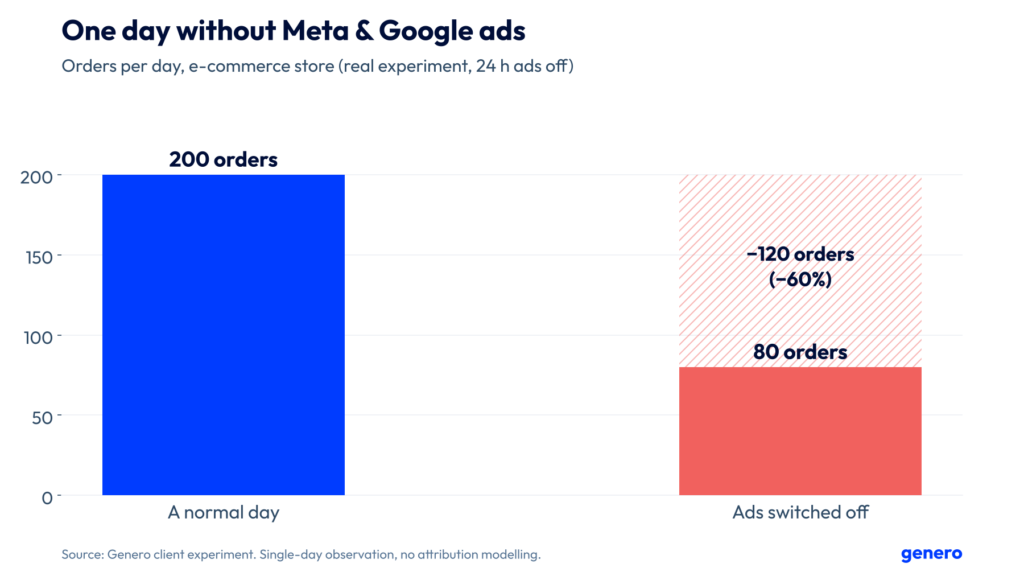
We turned off ALL Meta and Google ads for 24 hours for an e-commerce store we work with. 🫣
What do you think happened?
They got 80 orders instead of their usual 200.
That’s a 60% drop in sales. In just one day.
Pausing ads is almost never a good idea. But sometimes you learn a lot by doing it. Here’s what this one day taught us, and what the bigger studies say about the same question.
1. Ad spend isn’t just a cost
Think of it as putting your products on the shelves where people are shopping. Stop paying for shelf space, and your products become much harder to find.
A common objection is that people will just find you anyway, through Google’s organic results. The data says otherwise. When Google analysed more than 400 cases where advertisers paused their search campaigns, 89% of the paid clicks simply disappeared. Organic results didn’t pick them up. A follow-up covering more than 5,300 cases landed at 85%.
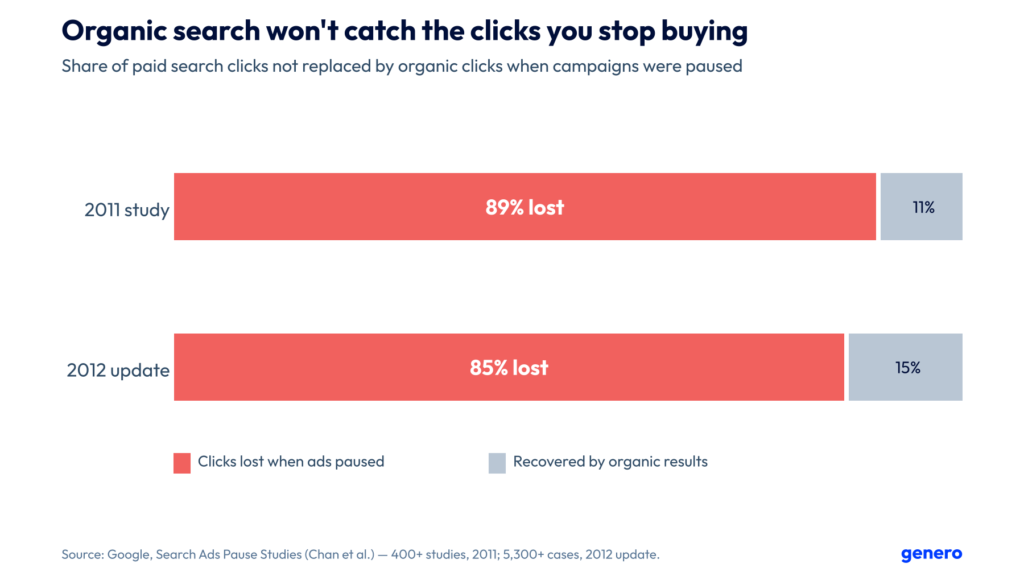
Yes, those are Google’s own numbers and they’re over a decade old. But they match what we saw: switch off the shelf space and most of that traffic just goes somewhere else.
2. Roughly 40% of sales remained. 60% disappeared.
In this particular case, the results suggest a large dependency on paid advertising. Your numbers might look very different.
And a single day only shows the immediate hit. Research from the Ehrenberg-Bass Institute shows what happens when brands stay dark for longer. Brands that stopped advertising for a year or more saw sales fall 16% after one year, 25% after two and 36% after three. A larger replication across 365 US brands found market share falling at a steady pace: about 10% a year, reaching 28% after three years. Smaller brands, and brands already in decline, lost the most.
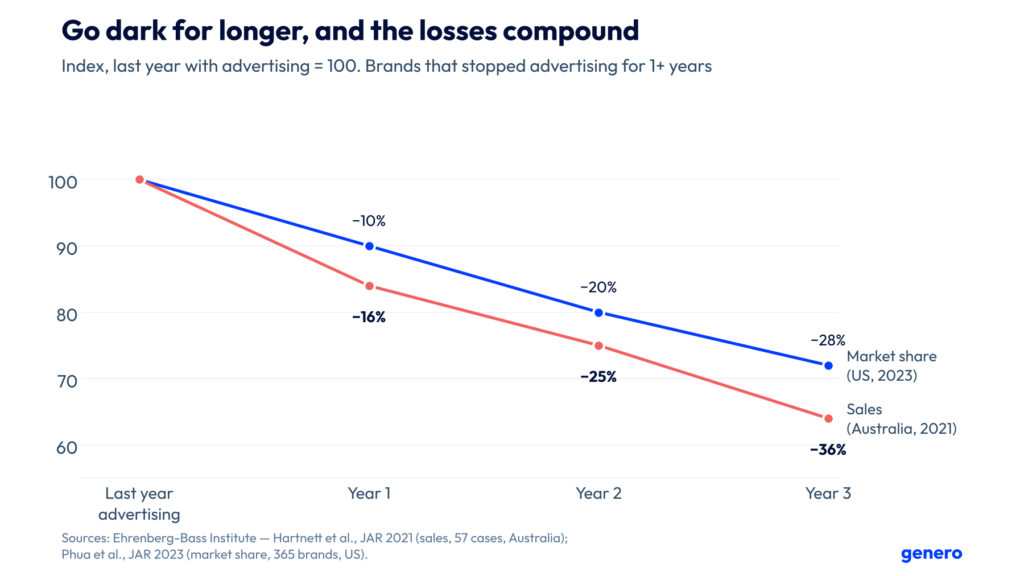
The losses don’t level off. They compound.
3. Returning customers held up. New customers didn’t.
Returning customers made up an unusually large share of the orders that day. New customer orders dropped significantly, while returning customers were much more resilient.
This supports the idea that advertising plays a major role in acquiring new customers, while existing customers are more likely to find their way back through brand searches and direct visits. It’s also in line with what Ehrenberg-Bass researchers have argued for years: brands grow by reaching new and light buyers, not just by holding on to the loyal ones.
The demand didn’t disappear. It moved.
Here’s something worth thinking about:
The total number of people buying products in that market probably didn’t change that day. They just bought from someone else.
Marketing spend is an investment in acquiring customers today who, with a great product and customer experience, can become returning customers tomorrow.
A short experiment, not the full story
Of course, this was a very short and limited real-world experiment. No complicated attribution models, just switching off the ads and observing what happened.
It doesn’t tell the full story. But it certainly tells us something. And when the same pattern shows up in Google’s pause studies and in years of going-dark research, it’s worth taking seriously.
If you are not advertising at the right level now, how much sales are you leaving on the table for the ones that are?
Sources
Google Research (2011): Studies Show Search Ads Drive 89% Incremental Traffic
Google Research (2012): Search Ads Pause Studies Update
Hartnett, Gelzinis, Beal, Kennedy & Sharp (2021), Journal of Advertising Research, via Marketing Week
Phua, Hartnett, Beal, Kennedy & Trinh (2023): When Brands Go Dark: A Replication and Extension, Journal of Advertising Research

About the author
Jonathan Björkskog
I am the Co-founder of Widetoes, a fast-growing multibrand e-commerce store selling wide shoes across the Nordics & EU. We help people find good-looking and healthy shoes that actually fit their feet, both online and in-store, and are now expanding internationally.
I’m also a founding partner at Genero, where I’ve spent 15+ years helping Enterprises, E-commerce, Media companies and B2B brands create and execute growth marketing plans. I’ve focused on helping them use marketing budgets as smart as possible, balancing Brand, Performance, and Distribution, to maximize growth or profitability.
Occasionally, I speak and share knowledge about ecommerce, marketing, growth, and entrepreneurship.